
Indian cattle field guide
50 Cow Breeds in India
A detailed guide to indigenous Indian cattle, their breeding tracts, characteristics, traditional uses, and recorded milk yields.
Introduction to Indian Cow Breeds
In the modern day, India is especially known for housing a large number of cattle. Global milk production in 2019 was estimated to be worth around 268 billion dollars, with India, the USA, China, Pakistan, and Brazil leading the way.
The genetic resources of cow breeds in India are among the largest in the world. India is the third-richest biodiversity country in Asia. There are 192.49 million cattle in India, including 43 registered native Indian cow breeds and nondescript cattle populations. Of the total cattle, around 48 million are dairy cattle.
Some indigenous cow breeds are well adapted to the agro-climatic conditions of India, while others perform well in countries around the world for milk, meat, or related agribusiness. Many indigenous breeds have declined because maintaining them can be unprofitable.
Indigenous cow breeds offer advantages such as disease resistance, low-input management, and survival in extreme weather, making them important in a changing climate.
A cow is multipurpose livestock because it can provide milk, meat, hides, and draught power. Since domestication, cattle have also played a significant role in human culture through races, ceremonies, and other traditions. Cow husbandry requires organized management, contributing to the complex nature of early agricultural societies.
The spread of domestic cattle across continents and their adaptation to different environments created many types of cows. In recent centuries, selective breeding further emphasized specialized and genetically distinct traits.
Inside each profile
Alternative names, primary use, breeding tract, visible characteristics, origin, colour, horn shape, and reported milk yield.
Indian cow names are often derived from the breed’s traditional breeding tract.
01
Amritmahal cow
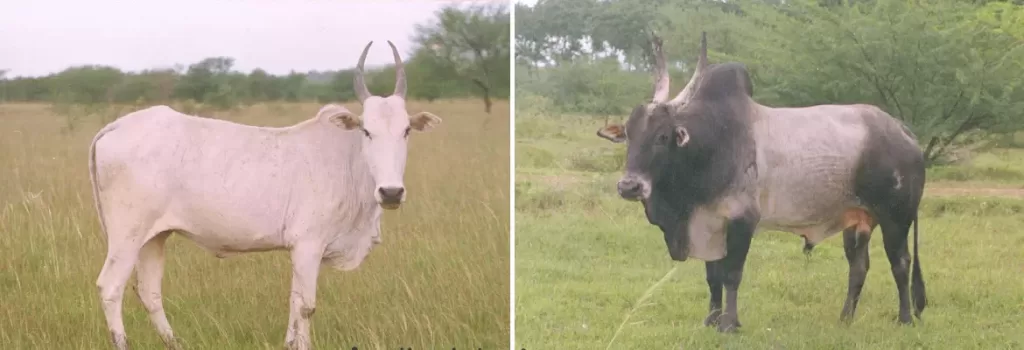
A draught breed known for its power and endurance. Amritmahal breed is fiery and active indian breed cow. Bullocks are particularly well suited for trotting and fast transportation. Amritmahal cow Amritmahal Bull cow breeds in india LeftAmritmahal cow Right : Amritmahal Bull
Other names of Amritmahal cow breeds in indiaDoddadana, Jawari Dana, Number Dana
Amritmahal breed Main UseWork – Transport and Draught
Amritmahal breed Breeding TractKarnataka
Amritmahal breed Visible CharacteristicsAmritmahal cow breed has long horns. They have long head tapering downward to the muzzle.
Amritmahal breed OriginThe Mysore ruler established a herd between 1572 and 1636 AD. In Hindi, Amrit means milk and Mahal means house; this breed was developed from a southern Indian draft breed to increase milk productivity.
Amritmahal breed ColourGrey, but can range from white to almost black. Some animals have white gray markings on their faces and dewlaps. There are dark shades on the neck, shoulders, hump, and hindquarters.
Amritmahal breed Horns Shape and SizeThe horns are long. The black points emerge from the top of the poll in a backward and upward direction, turn in and end in sharp black points — sometimes touching.
Amritmahal breed Milk yield per lactation(kg)572
02
Bachaur cow
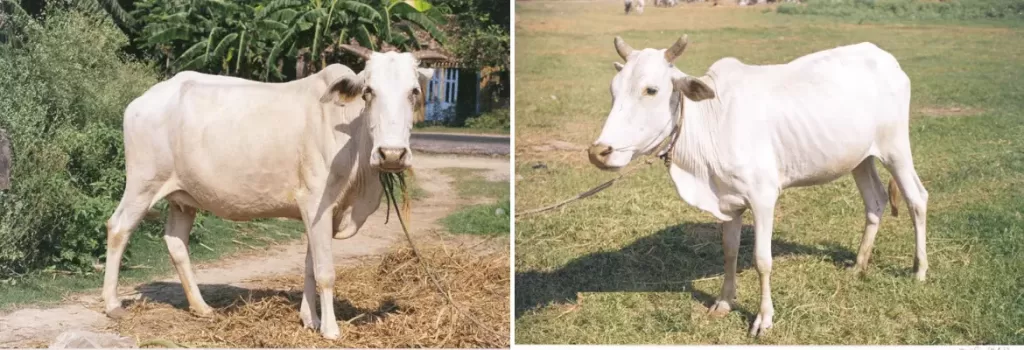
Bullocks of the Bachaur breed can work for long periods of time without taking any breaks. Bachaur cow Bachaur Bull cow breeds in india LeftBachaur cow Right : Bachaur cow
Other names of Bachaur cow breeds in indiaBhutia
Bachaur breed Main UseWork – Draught
Bachaur breed Breeding TractBihar
Bachaur breed Visible CharacteristicsBachaur cow breed is medium sized with straight backs. The forehead is flat or slightly convex.
Bachaur breed OriginBachaur breed is similar to the Hariana breed.
Bachaur breed ColourGrey or white.
Bachaur breed Horns Shape and SizeThey have small, stumpy horns curving outward as well as upward and downward.
Bachaur breed Milk yield per lactation(kg)225 – 630 (347 average)
03
Badri cow
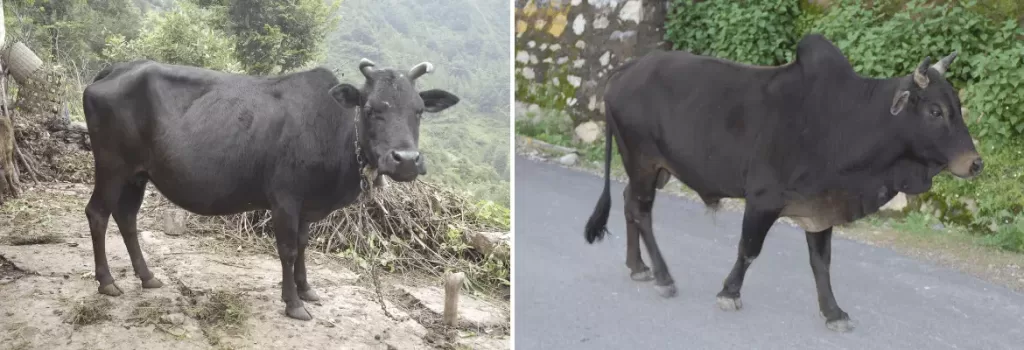
Raised primarily for bullock power, milk, and manure. Badri cow Badri Bull cow breeds in india LeftBadri cow Right : Badri Bull
Other names of Badri cow breeds in indiaPahadi
Badri breed Main UseMilk and Draught
Badri breed Breeding TractUttarakhand
Badri breed Visible CharacteristicsBadri cow breed is Small, active, and sure-footed. With a prominent poll and a medium to large hump, the forehead is straight. Has a small udder which is tucked up with the body.
Badri breed OriginBadri cow breed is Indigenous. The breed is found in Uttarakhand’s hilly regions.
Badri breed ColourBrown, Black or Grey. Females cows are also sometimes white in colour.
Badri breed Horns Shape and SizeCurved upwards and inwards. Males have10-22cm tall horns while females have 15-25cm tall horns.
Badri breed Milk yield per lactation(kg)547 – 657 (632 average)
04
Bargur cow
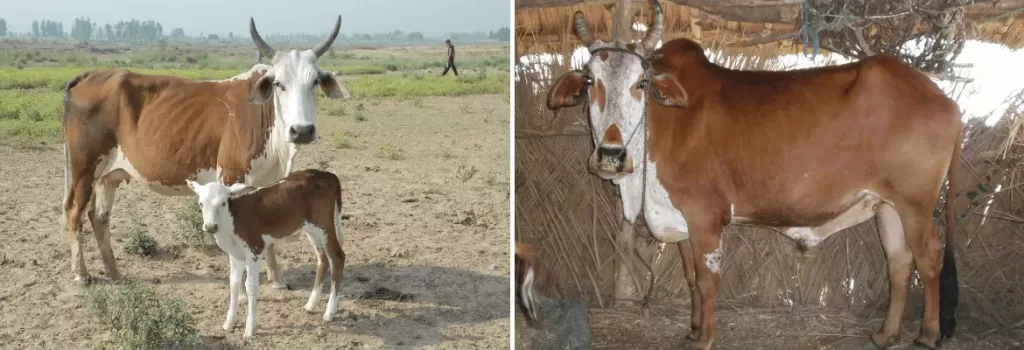
Compared to other Indian breed cows, the disposition of Bargur cattle is very sensitive and fiery, making them difficult to train. Designed primarily for carrying out agricultural operations on uneven and hilly terrain, they are light in construction. Its speed and endurance in trotting can’t be matched by any other breed. Bargur cow Bargur Bull cow breeds in india LeftBargur cow Right : Bargur Bull
Other names of Bargur cow breeds in india-None-
Bargur breed Main UseWork – Draught
Bargur breed Breeding TractTamilnadu
Bargur breed Visible CharacteristicsBargur cow has light brown horns. Fur colour can be brown with prominent white markings.
Bargur breed OriginCows of this breed can be found in the Bargur hills of Bhavani taluk in Erode district.
Bargur breed ColourBrown with white marks.
Bargur breed Horns Shape and SizeWith a forward curve, the horns are inclined backward, outward and upward at the root; they are sharp at the tip. The horns are medium in size and light brown in color.
Bargur breed Milk yield per lactation(kg)250 – 1300 (350 average)
05
Belahi cow
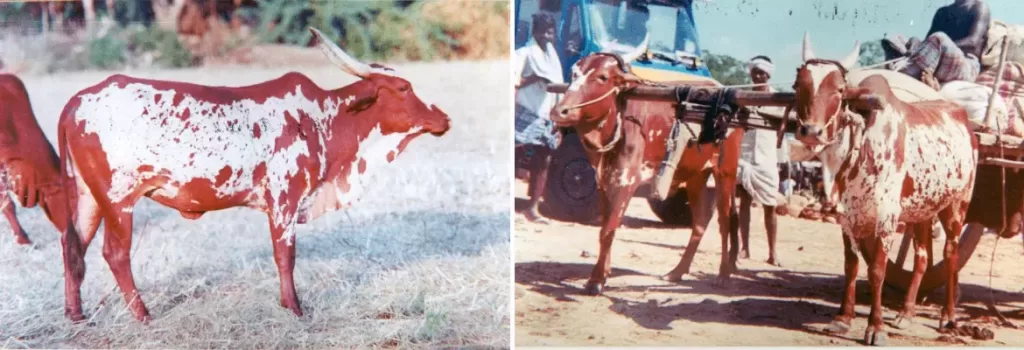
Belahi cattles are local and are named after their body color patterns. The term ‘Belaha’ is used to describe a combination of colors. For generations, Gujjars also known as Langarias have maintained these Indian breed cows. Belahi cow Belahi Bull cow breeds in india LeftBelahi cow Right : Belahi Bull
Other names of Belahi cow breeds in indiaMorni, Desi
Belahi breed Main UseMilk, Draught and Manure
Belahi breed Breeding TractHaryana, Chandigarh
Belahi breed Visible CharacteristicsThese breed cows are medium sized. The body has a reddish brown colour pattern, with a white face and extremities and a white ventral region of variable intensity. With prominent poll, this animal has a straight, broad head.
Belahi breed OriginCows of this breed can be found in the Bargur hills of Bhavani taluk in Erode district.
Belahi breed ColourWhite or reddish-brown and grey.
Belahi breed Horns Shape and SizeThe horns are sickle-shaped, curving upwards and inwards. The average size of a male horn is 27.2cm and the average size of a female horn is 25.4cm.
Belahi breed Milk yield per lactation(kg)182 – 2092 (1014 average)
06
Binjharpuri cow
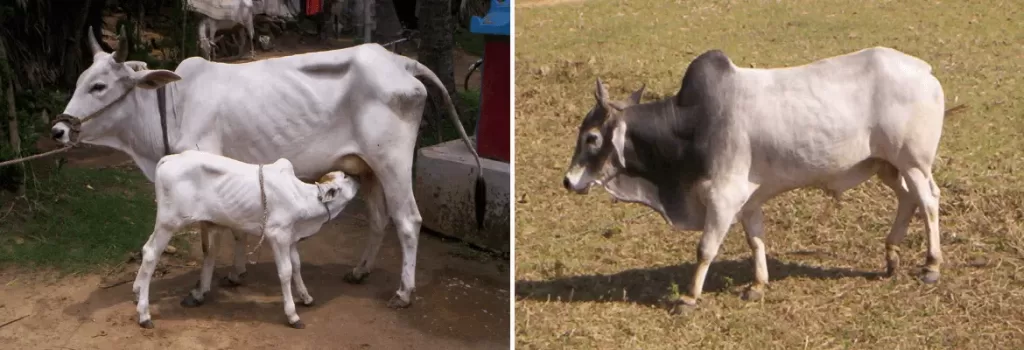
Binjharpuri cows are dual purpose indigenous Indian cow breeds. This breed is found in the entire Jajpur district and adjoining areas of Kendrapara and Bhadrak. Areas with high concentrations include Bari, Binjharpur, and Dasrathapur in Jajpur district. Binjharpuri cow Binjharpuri Bull cow breeds in india LeftBinjharpuri cow Right : Binjharpuri Bull
Other names of Binjharpuri cow breeds in indiaDeshi
Binjharpuri breed Main UseFood-Milk, Work- Draught, manure
Binjharpuri breed Breeding TractOdisha
Binjharpuri breed Visible CharacteristicsThese breed cows are medium sized and strong. In males, the hump, neck, and some regions of the face and back are black regardless of coat color.
Binjharpuri breed OriginBinjharpuri is an indigenous breed. They are named after the locality “Binjharpur” of Jajpur district in Orissa
Binjharpuri breed ColourWhite, grey, black or brown in colour.
Binjharpuri breed Horns Shape and SizeThe horns are curved upward and inward. Binjharpuri Male have horn length ranging 21.17±2.86 cm, Binjharpuri Females have horn length ranging 12.70±1.31cm.
Binjharpuri breed Milk yield per lactation(kg)915 – 1350
07
Dagri cow
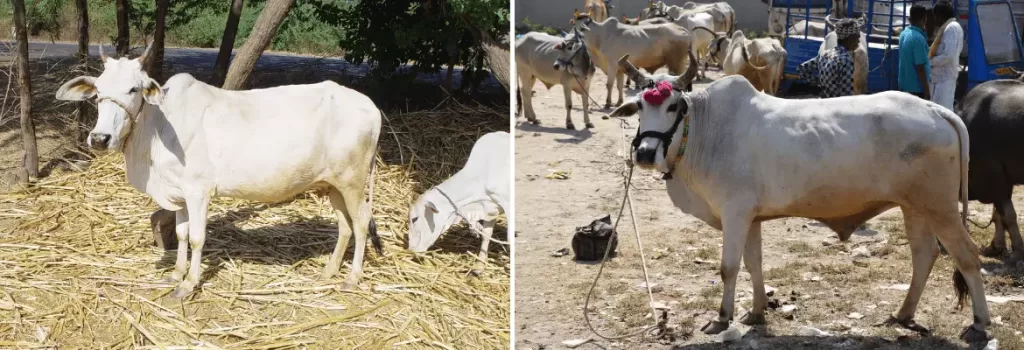
These Indian breed cows are mainly used for draught purpose. The quantity of milk it produces is less. A few cows aren’t milked at all by the farmers, their milk is primarily suckled by their male calves. In colloquial language, dagri means ‘Deshi’ or old or native. Dagri cow Dagri Bull Indian breed cows LeftDagri cow Right : Dagri Bull
Other names of Dagri cow breeds in indiaGujarat Malvi
Dagri breed Main UseDraught
Dagri breed Breeding TractGujarat
Dagri breed Visible CharacteristicsDagri cows are compact cattle with straight foreheads and short bodies.
Dagri breed OriginIndian Indigenous cow breed.
Dagri breed ColourGenerally white. However, grey coloured dagri cows are also there.
Dagri breed Horns Shape and SizeThe horns are short, thin, and curved upward in a lyre shape or straight with a pointed tip.
Dagri breed Milk yield per lactation(kg)75 – 650 (Average 316)
08
Dangi cow
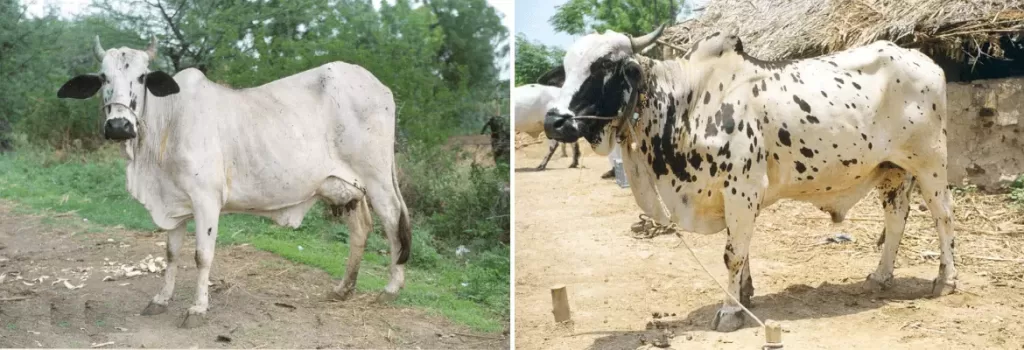
These Indian cattle breeds are mainly used for draught purpose. The quantity of milk it produces is less. A few cows aren’t Dangi breed cows are found primarily in the Akola taluka of the Ahmadnagar district, the Sinner taluka and Igatpuri taluka of the Nashik and Thane district of Maharashtra, and the Dangs district of Gujarat. In general, dangi cattle breed is found near mountains where forests are available in the Sahyadri range.
Besides ploughing, harrowing, and other field operations, Dangi Indian breed cows are also used for hauling timber from forest areas. It has excellent working qualities in heavy rainfall areas, rice fields, and hilly terrain. Dangi cow Dangi Bull Indian breed cows LeftDangi cow Right : Dangi Bull
Other names of Dangi cow breeds in indiaKandadi
Dangi breed Main UseMilk, draught
Dangi breed Breeding TractGujarat, Maharashtra, Haryana
Dangi breed Visible CharacteristicsDangi cattles have an uneven distribution of black or red spots on the body. There is a slight protrusion of the forehead.
Dangi breed OriginThe origin of dangi breed has multiple theories. The name dangi is derives from the marathi word “dang” meaning mountain. These Indian breed cows are called so because they are found in mountain regions. However, according to some, this breed originated in Gujarat’s Dangs district. Also, the synonym name Kandadi may suggest it originated in Karnataka.
Dangi breed ColourDangi cattle have a distinctive white coat colour with red or black spots distributed unevenly over the body.
Dangi breed Horns Shape and SizeShort horns aproximately 12-15 cm in length. The horns can be inward and downward pointing.
Dangi breed Milk yield per lactation(kg)175 – 800 (Average 430)
09
Deoni cow
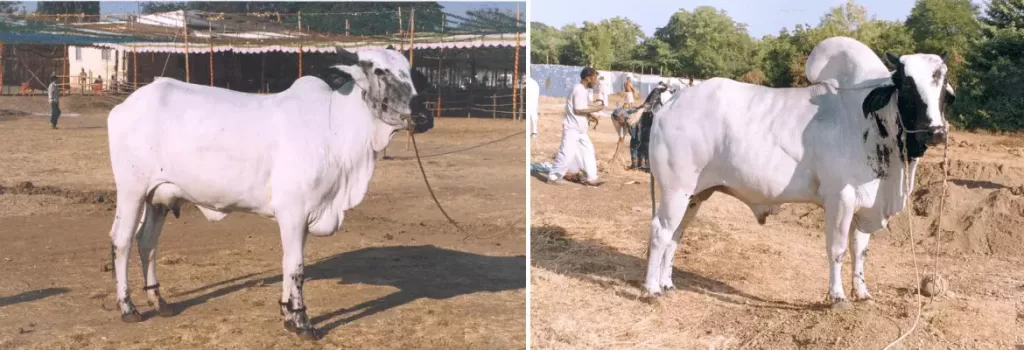
For heavy work, Deoni bullocks are preferred. At approximately 5 to 6 years of age, Deoni bullocks reach their maximum potential and maintain it through their adolescence i.e. for approximately 12 years. Breeding tracts of deoni cattle extend from the Balaghat range of the Sahyadri hills in the Kannad taluk of Aurangabad to the Deglur taluk of Marathwada region of Maharashtra. Deoni cow Deoni Bull Indian breed cows LeftDeoni cow Right : Deoni Bull
Other names of Deoni cow breeds in indiaSurti, Dongarpati, Dongri, Wannera, Waghyd, Balankya and Shevera
Deoni breed Main UseDraught, transport and milk
Deoni breed Breeding TractKarnataka, Maharashtra
Deoni breed Visible CharacteristicsBlack and white spotted body colour, drooping ears, prominent forehead and drooping ears are some of the characteristics of Deoni cows.
Deoni breed OriginIt is believed that Deoni cows have been developed from the Gir cow. The name of this breed comes from Deoni Taluk in Latur district. Deoni, Udgir, and Ahmadpur taluks of Latur district constitute the actual place of origin.
Deoni breed ColourSpotted black and white(Waghyd or Shevera) or complete balck (Balankya) or Partial black face with white body(Wannera).
Deoni breed Horns Shape and SizeFrom behind the eyes and on the side of the poll, the horns extend upward and outward. The horn is small in size and has blunt tips.
Deoni breed Milk yield per lactation(kg)638 – 1229 (Average 868)
10
Gangatiri cow
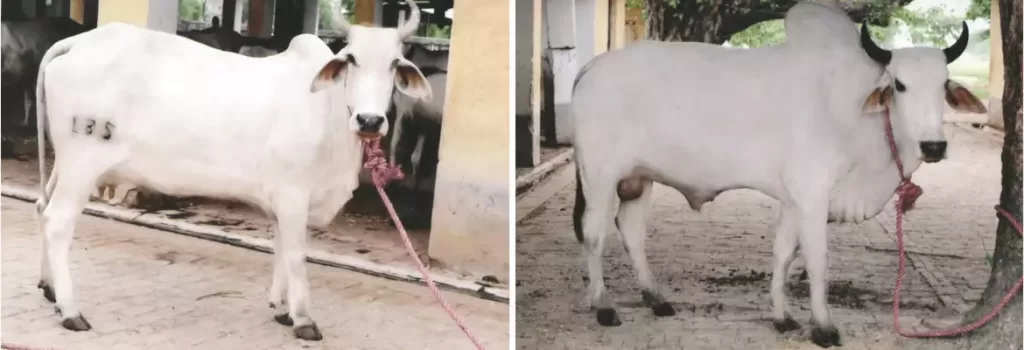
The Gangatiri breed is an average milk producer with good draftability. Primary Gangatiri cow breed is found in Ghazipur, Ballia, Varanasi, Mau, Mirzapur and adjoining districts of Uttar Pradesh and Bhabhua and Buxar and Bhojpur districts of Bihar. Gangatiri cow Gangatiri Bull Indian breed cows LeftGangatiri cow Right : Gangatiri Bull
Other names of Gangatiri cow breeds in indiaShahabadi, Eastern Hariana
Gangatiri breed Main UseDraught, manurte, milk
Gangatiri breed Breeding TractUttar Pradesh, Bihar
Gangatiri breed Visible CharacteristicsForeheads of Gangatiri cows are straight and broad with a shallow groove in the middle. Generally, the eyelids, muzzle, hooves, tail switch, and muzzle are black.
Gangatiri breed OriginGangatiri cow name is derived from the river Ganga .
Gangatiri breed ColourWhite(Dhawar) or Grey(Sokan) .
Gangatiri breed Horns Shape and SizeGangatiri cows horns are medium sized. The horns emerge from the sides of the poll around the eye and curvature upward until pointing forwards.
Gangatiri breed Milk yield per lactation(kg)900 – 1200 (Average 1050)
11
Gaolao cow
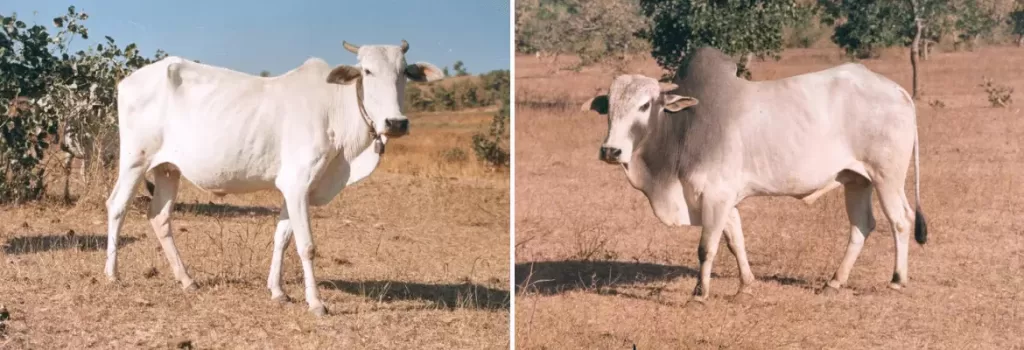
The Gaolao cattle breed is a fast trotting breed ideal for rapid transportation in hilly terrain. Gaolao cow Gaolao Bull Indian breed cows LeftGaolao cow Right : Gaolao Bull
Other names of Gaolao cow breeds in indiaGaulgani, Arvi
Gaolao breed Main UseMilk, transport
Gaolao breed Breeding TractMaharashtra, Madhya Pradesh
Gaolao breed Visible CharacteristicsGaolao cattle have a head that is markedly long and narrow, tapering towards the muzzle. Towards the top of the head, the forehead recedes slightly, giving it a convex appearance. The eyes are almond-shaped and slightly angled.
Gaolao breed OriginThese Indian breed cows were developed by the Nanda Gawali community. Although it is very similar to Ongole cattle breed, it is lighter and has greater agility.
Gaolao breed ColourMales are blackish white and females are white. The necks of males are generally grey.
Gaolao breed Horns Shape and SizeGaolao cows have short and stumpy horns which are curve slightly backward.
Gaolao breed Milk yield per lactation(kg)470 – 725 (Average 604)
12
Ghumusari cow
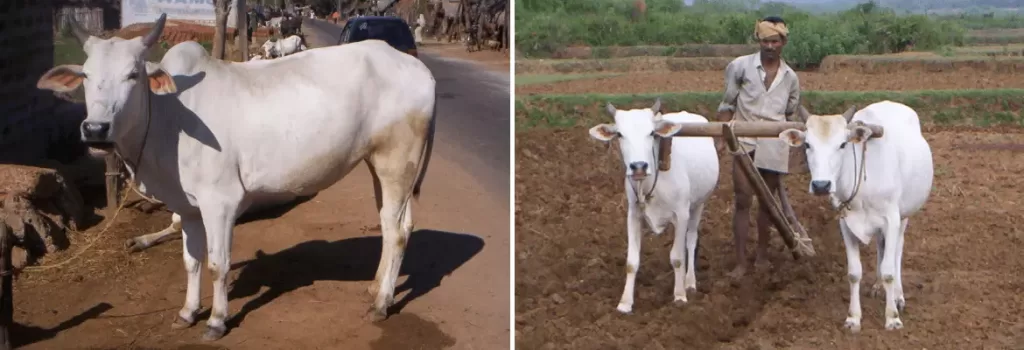
Ghumusari is draft breed. They are found in western part of Ganjam district and the adjacent areas of Phulbani district. Areas of Ganjam district with a high concentration of this breed are Bhanjanagar, Sorada, and Aska. Ghumusari cow Ghumusari Bull Indian breed cows LeftGhumusari cow Right : Ghumusari Bull
Other names of Ghumusari cow breeds in indiaDeshi
Ghumusari breed Main UseDraught, Manure, milk
Ghumusari breed Breeding TractOdisha
Ghumusari breed Visible CharacteristicsGhumusari cattles are strong, small sized draft type cattles. They have a small head with a flat, broad and depressed forehead between the eyes.
Ghumusari breed OriginGhumusari is an Indian Indigenous cow breed. They are named after the locality “Ghumusar” in the Ganjam and Phulbani districts of Orissa.
Ghumusari breed ColourPrimarily white but sometimes grey.
Ghumusari breed Horns Shape and SizeGhumusari cattle have horns that are curved upward and inward. Some cattle might have straight horns. Ghumusari bulls have average horns length of 8.72±1.54, Ghumusari Cows have average horns length of 7.47±1.67cm
Ghumusari breed Milk yield per lactation(kg)450 – 650
13
Gir cow
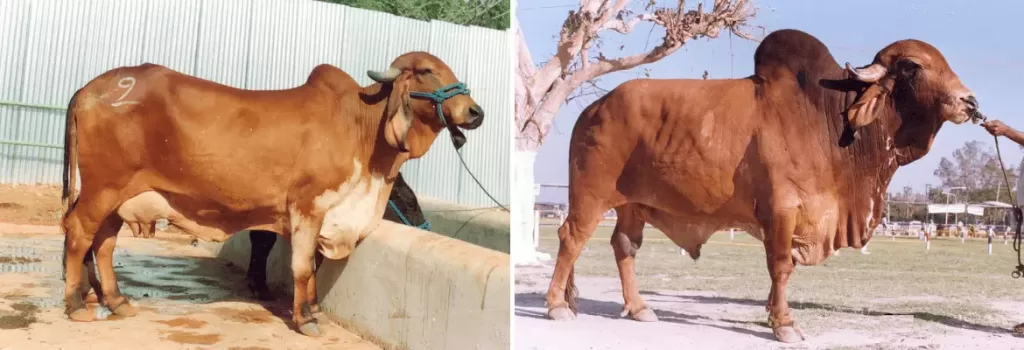
Milk production is excellent in gir cows. All kinds of soil can be dragged by Gir bullocks, from sand to rocky substrates. Found in Gujarat’s Saurashtra region, especially Gir forest. Gir cow Gir Bull Indian breed cows LeftGir cow Right : Gir Bull
Other names of Gir cow breeds in indiaBhodali, Desan, Gujarati, Kathiawari, Sorthi, and Surati
Gir breed Main UseMilk
Gir breed Breeding TractGujarat
Gir breed Visible CharacteristicsA gir cattle has long, pendulous ears that fold like a leaf. Gir cows ears face forward.
Gir breed OriginGir is the name of the forest where the breed originated.
Gir breed ColourPure red or speckled red.
Gir breed Horns Shape and SizeThe horns of gir cows are peculiarly curved. Taking a sideways downwards and backwards curve at the base of the crown, they then incline upwards, taking a spiral inward sweep, ending in a fine taper, giving it a half moon appearance.
Gir breed Milk yield per lactation(kg)800 – 3300 (Average 2110)
14
Hallikar cow
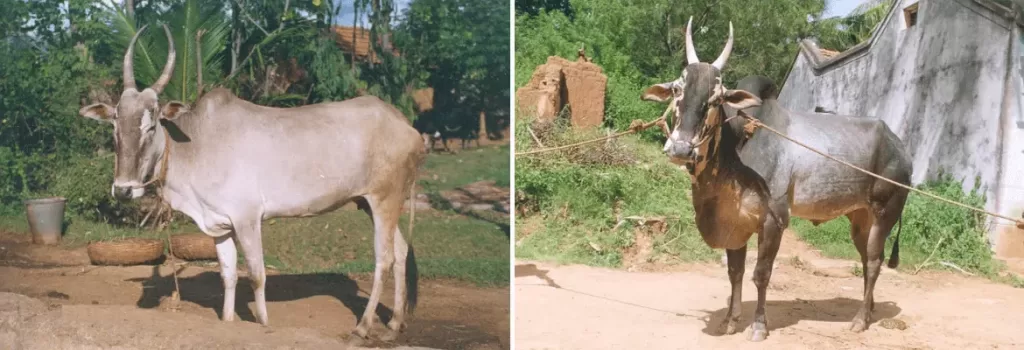
Nearly every district of south Karnataka has the Hallikar breed of cattle. These Indian breed cows are also found in adjoining areas of the states of Andhra Pradesh and Tamilnadu. Among the best draught breeds of southern India. The majority of South Indian breed cows have their origins from this breed. Hallikar cow Hallikar Bull Indian breed cows LeftHallikar cow Right : Hallikar Bull
Other names of Hallikar cow breeds in indiaMysore
Hallikar breed Main UseDraught
Hallikar breed Breeding TractKarnataka
Hallikar breed Visible CharacteristicsWhite markings or irregular patches can be found around the eyes and cheeks, as well as the neck and shoulders of Hallikar cattle.
Hallikar breed OriginHallikar is the name of a breed derived from the name of the sub tribe of the Golla community that is primarily responsible for breeding the breed.
Hallikar breed ColourLight grey to white with dark shading on hind quarters and shoulders particularly in young bulls.
Hallikar breed Horns Shape and SizeFrom the top of the poll, the horns emerge near each other, are carried upward and backward for nearly half their length, and bend forward and slightly inward to end with pointed tips.
Hallikar breed Milk yield per lactation(kg)227 – 1134 (Average 542)
15
Hariana cow
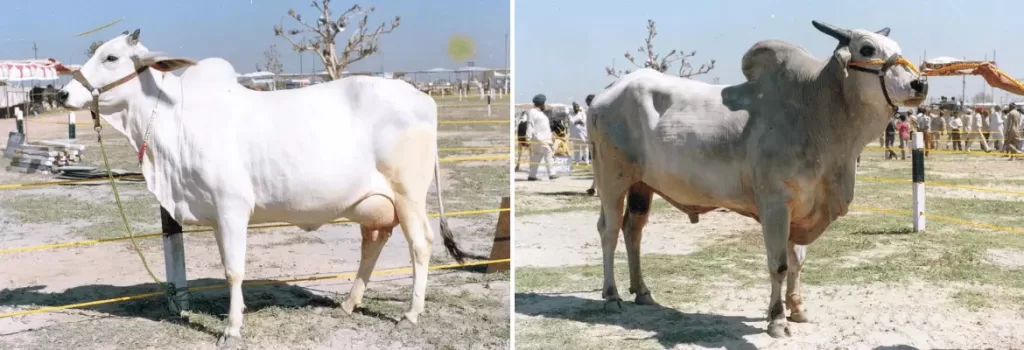
In north India, the Hariana Indian breed cows are famous for its dual purpose – it is widely spread on the Indo Gangetic plains. Generally, they are reared to produce bullocks. Hariana cow is also a decent milker. Hariana cow Hariana Bull Indian breed cows LeftHariana cow Right : Hariana Bull
Other names of Hariana cow breeds in indiaHansi
Hariana breed Main UseDraught, milk , transport
Hariana breed Breeding TractHaryana
Hariana breed Visible CharacteristicsHariana cattles are White coloured , with long and narow face, the centre of the poll has well-defined bony prominence and the horns are small.
Hariana breed OriginThe Hariana cattle get their name from a region of North India known as Haryana. The region had two strains of cattle, Hisar and Hansi, named after the towns in which they originated. Hariana cattle are believed to have originated from these two strains. The names Hisar and Hansi do not exist today.
Hariana breed ColourLight grey or white in colour. Hariana bulls have noticiable darker grey fore and hind quarters.
Hariana breed Horns Shape and SizeHariana cattles have small horns.
Hariana breed Milk yield per lactation(kg)693 – 1745 (Average 997)
16
Himachali Pahari cow
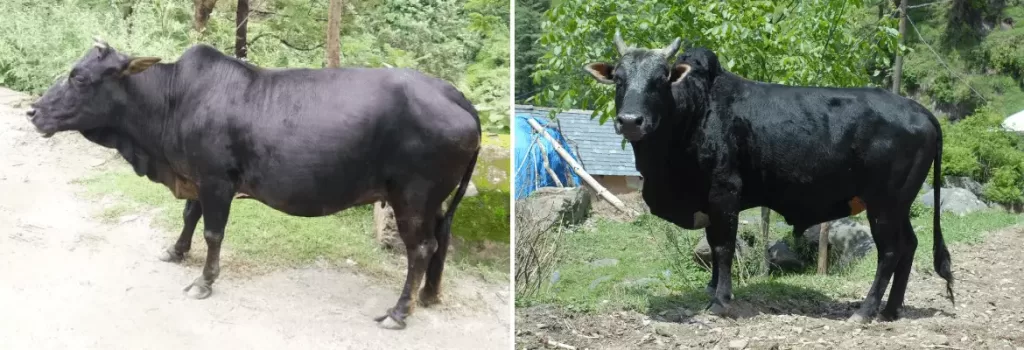
This breed is suitable for sub-tropical/sub-humid/temperate/cold mountainous type ecosystem. Cattle of this breed are capable of working on narrow, sloppy, undulating, hilly terrain. Himachali Pahari cattles have a moderate draught performance. Himachali Pahari cow Himachali Pahari Bull Indian breed cows LeftHimachali Pahari cow Right : Himachali Pahari Bull
Other names of Himachali Pahari cow breeds in indiaPahari, Desi, local, Gauri, Himdhenu, pahadi
Himachali Pahari breed Main UseDraught, manure, milk
Himachali Pahari breed Breeding TractHimachal Pradesh
Himachali Pahari breed Visible CharacteristicsHimachali Pahari cattles are Small to medium sized cattles with compact cylindrical body. They have short legs, medium hump, horizontally placed ears and comparatively long tail.
Himachali Pahari breed OriginHimachali Pahari cattle is an Indian Indeginous breed. Named such due to being native to hills.
Himachali Pahari breed ColourBlackish brown or black.
Himachali Pahari breed Horns Shape and SizeTheir horns are medium in size and curved primarily in the lateral and upward directions. Himachali Pahari bulls have average horns length of 16 cm, Himachali Pahari cows have average horns length of 13cm.
Himachali Pahari breed Milk yield per lactation(kg)300 – 650 (Average 538)
17
Kangayam cow
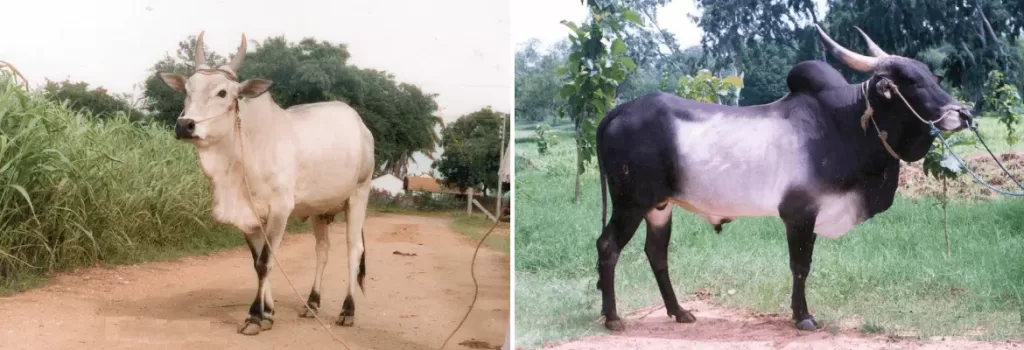
A Kangayam bullock has a good capacity for work and is used for all agricultural operations. Kangayam bullocks are used for sugarcane load hauling alone, although there are other draught breeds available in the area. Kangayam cattles are found in Kangayam and Dharapuram taluks of Erode district, and in Karur taluk of Karur district. Kangayam cow Kangayam Bull Indian breed cows LeftKangayam cow Right : Kangayam Bull
Other names of Kangayam cow breeds in indiaKongu, Kanganad
Kangayam breed Main UseDraught, transport
Kangayam breed Breeding TractTamilnadu
Kangayam breed Visible CharacteristicsKangayam cattle are characterized by long, nearly circular horns, a long hump and a strong body.
Kangayam breed OriginThe breed gets its name from Kangayam taluk of Erode district, part of Coimbatore district. Late Pattogar of Palayakottai developed this breed. The breed is similar to the Umblachery breed.
Kangayam breed ColourInitially, the calf’s coat is red, but it begins to turn grey after six months. A bull’s hump, fore and hind quarters, face, and legs are dark colored. Bullocks are grey in color. Generally, cows are gray or grey and white. It is common for kangayam cows to have dark gray face.
Kangayam breed Horns Shape and SizeStrong and long horns that sweep backward, outward, and upward, curving inward with tips that meet to form a crescent shape.
Kangayam breed Milk yield per lactation(kg)540
18
Kankrej cow
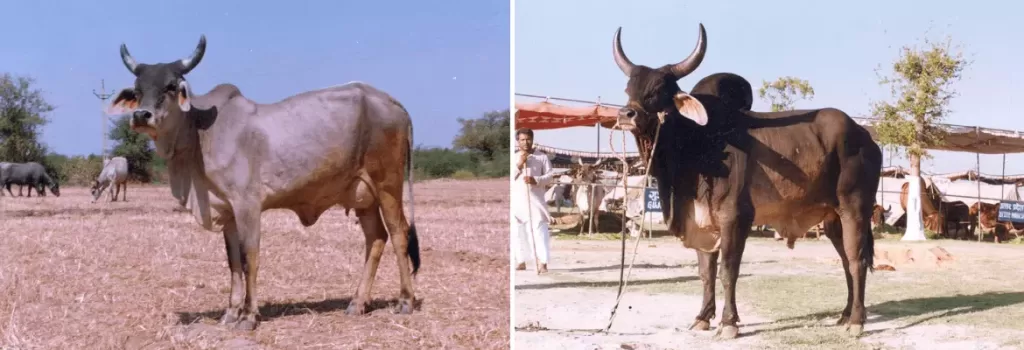
Kankrej indian breed cows are mostly used for farming. This breed of bullocks is mainly used for transportation in village areas. Kankrej cow Kankrej Bull Indian breed cows LeftKankrej cow Right : Kankrej Bull
Other names of Kankrej cow breeds in indiaTalabda, Nagar, Wadad, Waged, Bonnai, Vagadia
Kankrej breed Main UseDraught, milk, transport
Kankrej breed Breeding TractRajasthan , Gujarat
Kankrej breed Visible CharacteristicsCattle of this breed are the heaviest. A strong lyre-shaped horn, a large pendulsus, and open ears are prominent characteristics of this breed. are compact cattle with straight foreheads and short bodies.
Kankrej breed OriginThe name of this breed is derived from its geographical location Kank, a taluka of Banaskantha district in Gujarat.
Kankrej breed ColourSteel grey, iron grey or silver grey. Bullocks have darker hindquarters, forequarters, and hump than the rest of their body.
Kankrej breed Horns Shape and SizeHorns are curved outward and upward in a lyre-shaped.
Kankrej breed Milk yield per lactation(kg)800 – 1800 (Average 1738)
19
Kenkatha cow
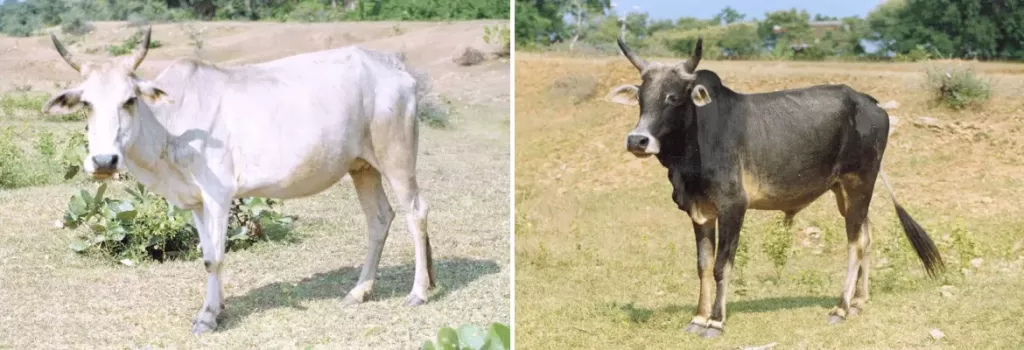
Cattles of the kenkatha breed are used for light draught on roads and for cultivation. A robust species well suited to the climatic conditions of Bundelkhand, with strong feet and well-developed legs. Kenkatha cow Kenkatha Bull Indian breed cows LeftKenkatha cow Right : Kenkatha Bull
Other names of Kenkatha cow breeds in indiaKenwaria
Kenkatha breed Main UseDraught
Kenkatha breed Breeding TractUttar Pradesh, Madhya Pradesh
Kenkatha breed Visible CharacteristicsKenkatha cattle are small, strong, and fairly powerful with a forward-facing horn.
Kenkatha breed OriginKenkantha cattle are bred along the banks of the river Ken in Bundelkhand, hence their name is also derived from the Ken river.
Kenkatha breed ColourGenerally, grey on the barrel and dark grey on the rest of body.
Kenkatha breed Horns Shape and SizeThe horns rise from the outer angles of the poll in a notably forward direction and end at sharp points.
Kenkatha breed Milk yield per lactation(kg)-NA-
20
Khariar cow
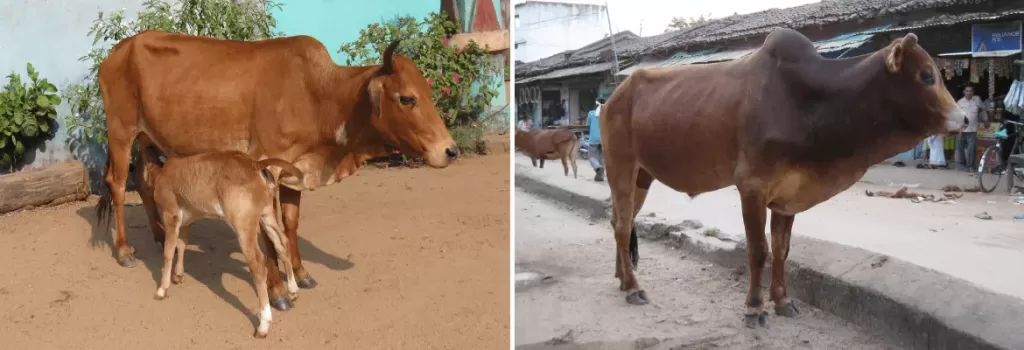
Khariar indian breed cows are essentially a draft breed used for draft power in their native habitat which is hilly and undulating in nature. Nuapada district and adjacent areas in Kalahandi and Balangir districts are native to khariar cattle breed. Khariar, Komna, Sinapali and Boden blocks of Nuapada district are heavily populated with this breed. Khariar cow Khariar Bull Indian breed cows LeftKhariar cow Right : Khariar Bull
Other names of Khariar cow breeds in indiaDeshi
Khariar breed Main UseDraught, manure, milk
Khariar breed Breeding TractOdisha
Khariar breed Visible CharacteristicsDagri cows are compact cattle with straight foreheads and short bodies.
Khariar breed OriginIndian Indeginous cow breed which is named after its native tract “Khariar” in Nuapada district.
Khariar breed ColourIts a small, strong draft cattle. The hump, neck, and some region of face and back are dark in colour.
Khariar breed Horns Shape and SizeHorns are Straight. Upwards and inwards quite frequently. Khariar bulls have average horns length of 12.34±0.21 cm, Khariar Cows have average horns length of 10.12±0.27 cm.
Khariar breed Milk yield per lactation(kg)300 – 450
21
Kherigarh cow
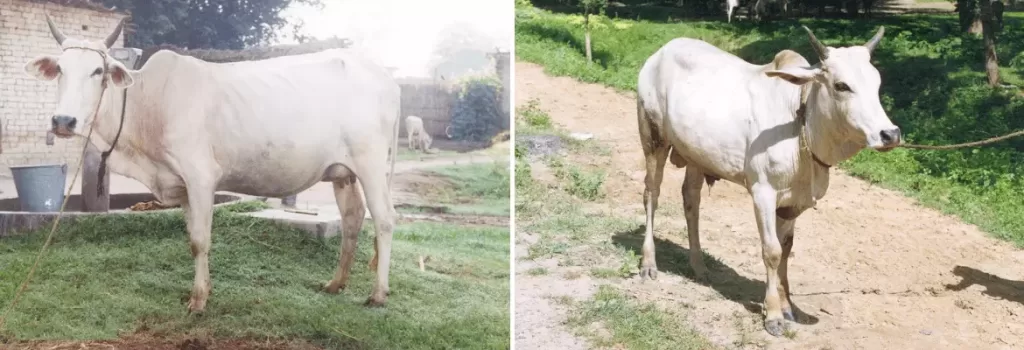
Kherigarh cattle breed is known for its fast running pace. Primarly used for draught purpose. Kherigarh cow Kherigarh Bull Indian breed cows LeftKherigarh cow Right : Kherigarh Bull
Other names of Kherigarh cow breeds in indiaKharigarh, Kheri, Khari, Khairagarh
Kherigarh breed Main UseDraught
Kherigarh breed Breeding TractUttar Pradesh
Kherigarh breed Visible CharacteristicsKherigarh are small cattles.
Kherigarh breed OriginNamed after the town Khairagarh in Uttar Pradesh.
Kherigarh breed ColourWhite or grey
Kherigarh breed Horns Shape and SizeThe horns are medium-sized (15 cm), upright, bending outward and upward. The base of the horns is thick.
Kherigarh breed Milk yield per lactation(kg)300 – 500
22
Khillar cow
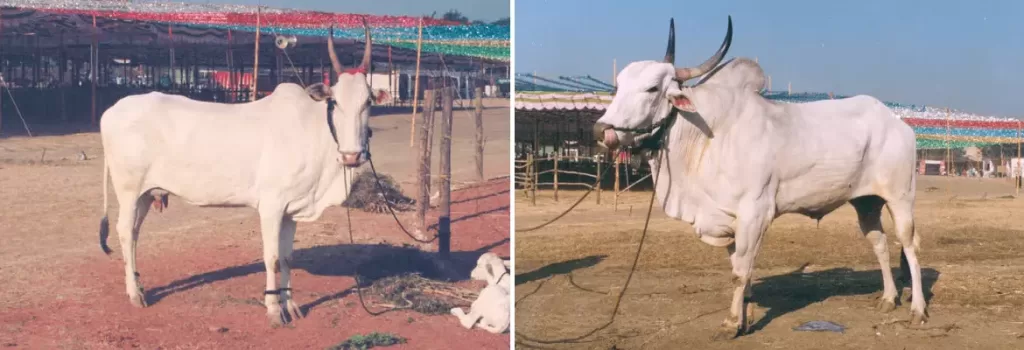
Khillar Bullocks are known for their quick draught ability. The term ‘Khillari’ refers to a herd of cattle and the person who tends them is known as a ‘Khillari’ or ‘Thillari’. Khillari can be found in four different types throughout India. Atpadi Mahal is in southern Maharashtra; Mhaswad is close to Satara and Solapur; Thillari is in the Satpura hills, and Nakali is nearby the adjoining region. Khillar cow Khillar Bull Indian breed cows LeftKhillar cow Right : Khillar Bull
Other names of Khillar cow breeds in indiaShikari, Mandeshi, Thillar
Khillar breed Main UseDraught
Khillar breed Breeding TractMaharashtra, Karnataka
Khillar breed Visible CharacteristicsKhillar cattle have long, bow-shaped horns. From the nasal bridge to the center of the poll, there is a distinct ridge on the forehead. Prominent and sharp nasal bridge.
Khillar breed OriginBreed of cattle descended from breeding of Hallikar and Amritmahal.
Khillar breed ColourGreyis-white.
Khillar breed Horns Shape and SizeLong and pointed, the horns follow the curve of the forehead. Located closely at the root and with a thick base, they grow backwards for half of their length and then turn upwards in a smooth bow shape unique to this breed, terminating in points.
Khillar breed Milk yield per lactation(kg)240 – 515 (Average 451.48)
23
Kokan Kapila cow
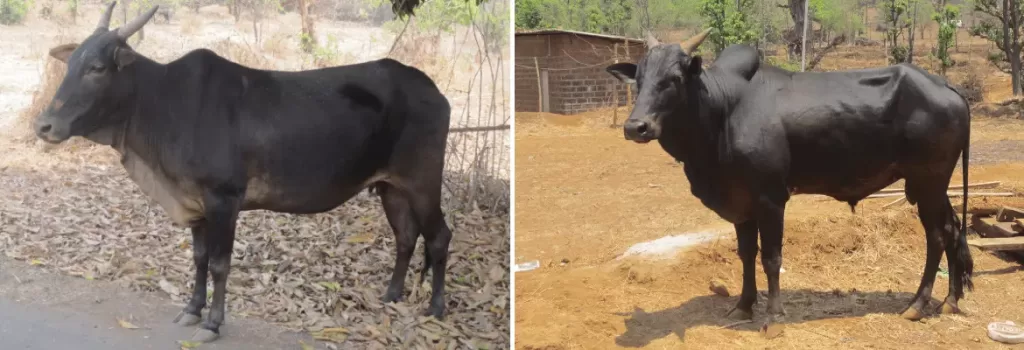
Kokan Kapila breed cattle are useful for farmers in all kinds of farming enterprises. Due to the lack of transport facilities, Konkan Kapila cows are the only source of milk in some parts of the Konkan area.
The animals can graze even in sloppy forest areas without feeling fatigued and are well adapted to low input production systems. The animals are very heat-tolerant. Kokan Kapila cow Kokan Kapila Bull Indian breed cows LeftKokan Kapila cow Right : Kokan Kapila Bull
Other names of Kokan Kapila cow breeds in indiaKonkan, Konkan gidda
Kokan Kapila breed Main UseDraught, manure, milk
Kokan Kapila breed Breeding TractMaharashtra
Kokan Kapila breed Visible CharacteristicsThey have compact bodies, horizontal ears, and straight foreheads and are small to medium sized cattle. Generally, the eyelids, muzzle, hoof, and tail switch are black.
Kokan Kapila breed OriginKokan kapila is an Indian Indeginous cow breed. It takes its name from its locality in Konkan belt of Maharashtra state and Kapila is the name given to cow in ancient Indian literature.
Kokan Kapila breed ColourVarious coat colours – reddish brown, black, wwhite/grey.
Kokan Kapila breed Horns Shape and SizeStraight horns rising outwards and backward, ending at a point. Kokan Kapila bulls have average horns length of 18.45 cm, Kokan Kapila Cows have average horns length of 18.30 cm.
Kokan Kapila breed Milk yield per lactation(kg)450
24
Kosali cow
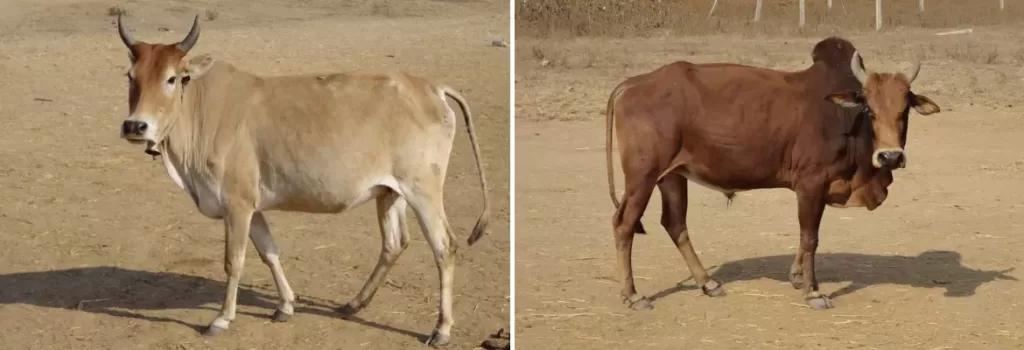
Kosali cattle breed is mostly found in the plains of Chhattisgarh. The Yadava/Rawuth community has kept this cattle generation after generation. Kosali cow Kosali Bull Indian breed cows LeftKosali cow Right : Kosali Bull
Other names of Kosali cow breeds in india-None-
Kosali breed Main UseDraught, manure, milk
Kosali breed Breeding TractChhattisgarh
Kosali breed Visible CharacteristicsKosali cattle have black muzzles, eyelids, tail switches, and hooves. It has a broad, flat, straight head. The size of the hump is small to medium. The udder is small and bowl-shaped.
Kosali breed OriginKosali is an Indian Indeginous cow breed. Its name is derived from ancient name of Chhattisgarh that is “Kowshal”.
Kosali breed ColourLight-red or whitish grey. Few kosali cattels are also found to have black coat or red coat with whitre patches.
Kosali breed Horns Shape and SizeKosali cattle has stuppy and short horns which can grow in any direction:inward, upward or outward. Kosali bulls have average horns length of 21 cm, Kokan Kapila Cows have average horns length of 12 cm.
Kosali breed Milk yield per lactation(kg)200 – 250 (Average 210)
25
Krishna Valley cow
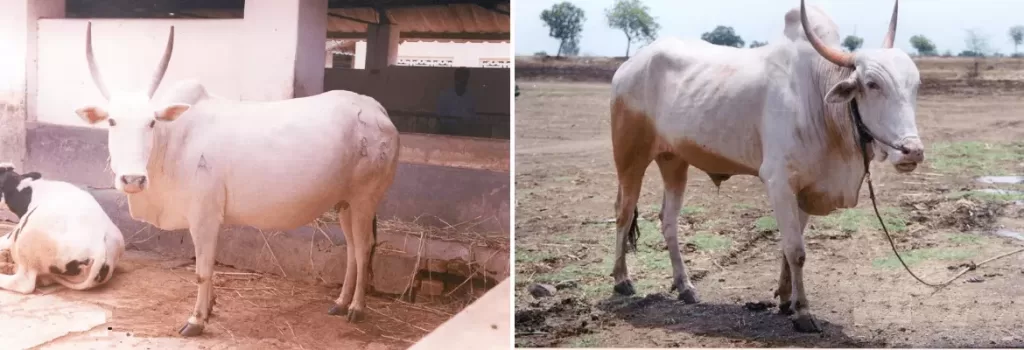
A heavy draught breed, this breed is used mainly in the black cotton soil of the watershed of the river Krishna. Krishna Valley cow Krishna Valley Bull Indian breed cows LeftKrishna Valley cow Right : Krishna Valley Bull
Other names of Krishna Valley cow breeds in indiaKistna Valley
Krishna Valley breed Main UseDraught
Krishna Valley breed Breeding TractMaharashtra, Karnataka
Krishna Valley breed Visible CharacteristicsKrishna valley cattles have a massive body with a prominent bulge on the forehead.
Krishna Valley breed OriginIt is an Indian Indeginous cow breed. Deriving its name from the krishna river, Krishna Valley cattle are descended from Gir cattle from Kathiawar, Ongole cattle from Andhra Pradesh, Kankrej cattle from Gujarat, and local cattle with Mysore blood.
Krishna Valley breed ColourGenerally grey – white in colour. Krishna Valley bullocks have darker hind and fore quarters. Krishna Valley cows are comapritively more white. Some varied colour patterns such as brown and white, black and white, or mottled, are also observed.
Krishna Valley breed Horns Shape and SizeThe horns are curved and small in size. They rise in an outward direction from the poll and curve slightly upward and inward.
Krishna Valley breed Milk yield per lactation(kg)-NA-
26
Ladakhi cow
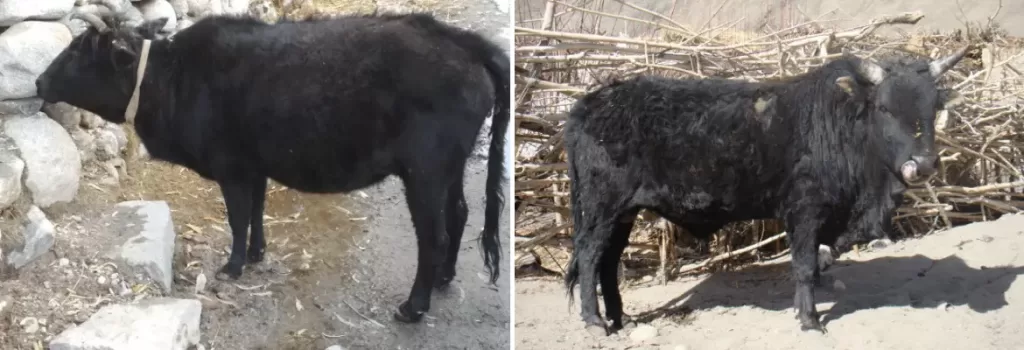
This cow’s milk is an important source of protein for the local population, especially during the lean winter months. The fat content of milk is high, around 5% and is used mostly for making butter and churpi, an important part of the local diet.
Ladakhi cattle are well adapted to high altitude, cold climates, and hypoxia. A compact body and short legs make it more suitable for mountainous territories. Ladakhi cow Ladakhi Bull Indian breed cows LeftLadakhi cow Right : Ladakhi Bull
Other names of Ladakhi cow breeds in india-None-
Ladakhi breed Main UseDraught, manure, milk
Ladakhi breed Breeding TractJammu & Kashmir
Ladakhi breed Visible CharacteristicsLadakhi cattle have a small, hairy forehead and a long face. Their legs are short and they have a small hump.
Ladakhi breed OriginLadakhi is an Indian Indeginous cow breed. Originating from the Ladakh region of J&K.
Ladakhi breed ColourBlack or brown.
Ladakhi breed Horns Shape and SizeHorns are mainly curved, pointing upward and forward with pointed tips over the forehead. Ladakhi bulls have average horns length of 16 cm, Ladakhi Cows have average horns length of 11 cm.
Ladakhi breed Milk yield per lactation(kg)-NA-
27
Lakhimi cow
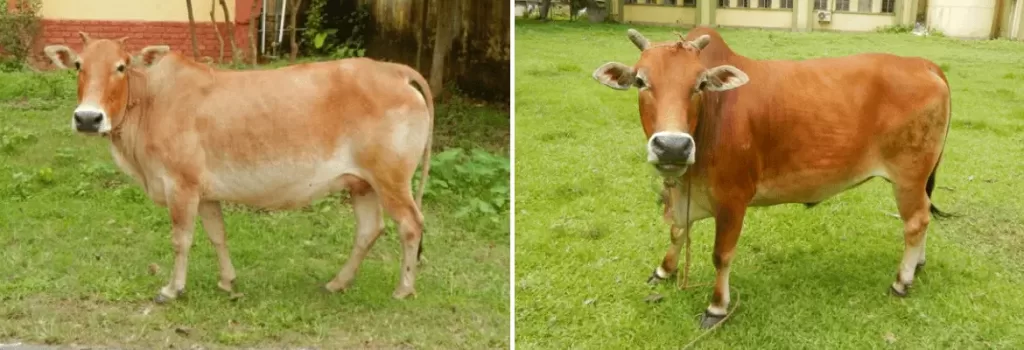
Locally known as Lakhimi, the indigenous cattle of Assam are found throughout the state. Especially in muddy fields for paddy cultivation, Lakhimi Bullocks are excellent draft animals for carting and plowing. Dairy products from Lakhimi cattle are high in fat, which is why they elicit a high price. Lakhimi cow Lakhimi Bull Indian breed cows LeftLakhimi cow Right : Lakhimi Bull
Other names of Lakhimi cow breeds in india-None-
Lakhimi breed Main UseDraught, milk
Lakhimi breed Breeding TractAssam
Lakhimi breed Visible CharacteristicsTypically, the legs of Lakhimi cattle are very short and the cattle are small. The coat color varies from brown to grey. It has a medium-sized hump and a slightly curved backline. It has a small Udder which is bowel shaped.
Lakhimi breed OriginLakhimi is an Indian Indeginous cow breed originated in Assam.
Lakhimi breed ColourGrey or Brown.
Lakhimi breed Horns Shape and SizeStraight shapped hons with average length of 17 cm.
Lakhimi breed Milk yield per lactation(kg)325 – 375 (Average 359)
28
Malnad Gidda cow
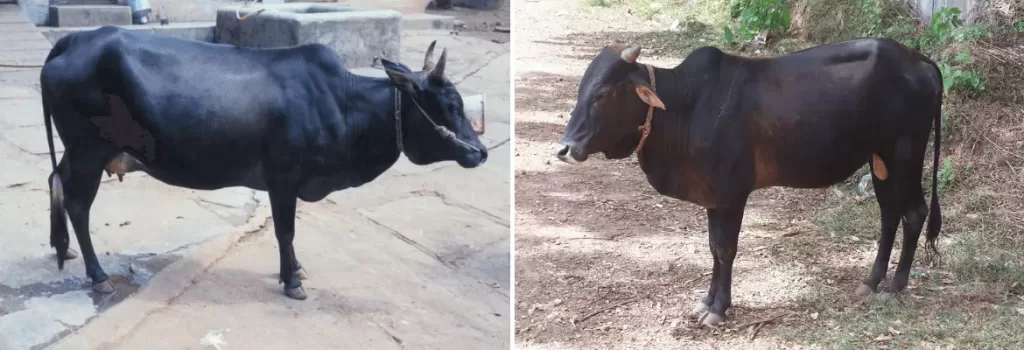
Well adapted to the local agro-ecological systems of the Western Ghats, malnad gidda cattles play an important role in the rural economy of this region by providing milk, manure, and draft power for little input. Malnad Gidda cow Malnad Gidda Bull Indian breed cows LeftMalnad Gidda cow Right : Malnad Gidda Bull
Other names of Malnad Gidda cow breeds in indiaVarshagandhi, Gidda, Uradana
Malnad Gidda breed Main UseDraught, manure, milk
Malnad Gidda breed Breeding TractKarnataka
Malnad Gidda breed Visible CharacteristicsWith a compact frame of around 80-120 kilos, Malnad gidda cattle is small and light. It has a black tail-switch and a small hump. The udder is small and is shaped like a bowl.
Malnad Gidda breed OriginIndian Indeginous cow breed.
Malnad Gidda breed ColourThe coat colour is black. Fawnish hues are also dominant on the thighs and shoulder region of the coat.
Malnad Gidda breed Horns Shape and SizeThe horns are commonly straight and small.
Malnad Gidda breed Milk yield per lactation(kg)218.3
29
Malvi cow
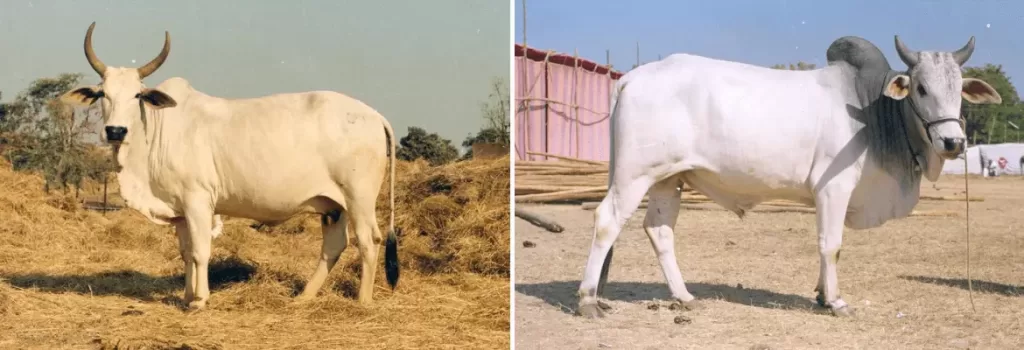
The Malvi cattle are known for their quick transportation, endurance, and ability to carry heavy loads on rough roads. Ratlam district and adjacent areas of Madhya Pradesh are also home to this cattle breed. Malvi cow Malvi Bull Indian breed cows LeftMalvi cow Right : Malvi Bull
Other names of Malvi cow breeds in indiaManthani, Mahadeo puri
Malvi breed Main UseDraught, transport
Malvi breed Breeding TractMadhya Pradesh
Malvi breed Visible CharacteristicsA Malvi cattle has a lyre shaped horn and is strong and well built.
Malvi breed OriginMalvi is an Indian Indeginous cow breed. It is named after Malwa region where it is found.
Malvi breed ColourMalvi cattle are white or white greyish in colour. The cattle has neck, shoulders, hump and quarters almost black in colour. With age, cows and bullocks’ colour changes to almost pure white.
Malvi breed Horns Shape and SizeThe horns are curved, rising outward and upward from the outer edge of the poll. Average length of the horn is 20-25 cm.
Malvi breed Milk yield per lactation(kg)627 – 1227 (Average 915.6)
30
Mewati cow
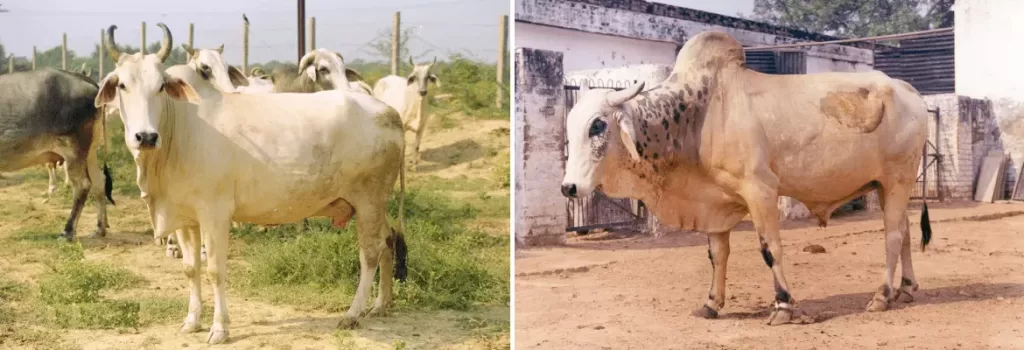
Strong and docile, Mewati cattle are ideal for heavy ploughing, carting, and drawing water from deep wells. Mewati cow Mewati Bull Indian breed cows LeftMewati cow Right : Mewati Bull
Other names of Mewati cow breeds in indiaMehwati, Kosi
Mewati breed Main UseDraught
Mewati breed Breeding TractRajasthan, Uttar Pradesh, Haryana
Mewati breed Visible CharacteristicsA Mewati cattle’s face is long and narrow with a straight, sometimes lightly protruding forehead.
Mewati breed OriginMewati is an Indian Indeginous cow breed. It is similar to Haryana, but there are traces of Gir, Kankrej, and Malvi breeds.
Mewati breed ColourWhite in colour. Quarters, neck and shoulders are of darker shade.
Mewati breed Horns Shape and SizeThe horns are small to medium in size with pinted tips.
Mewati breed Milk yield per lactation(kg)958
31
Motu cow
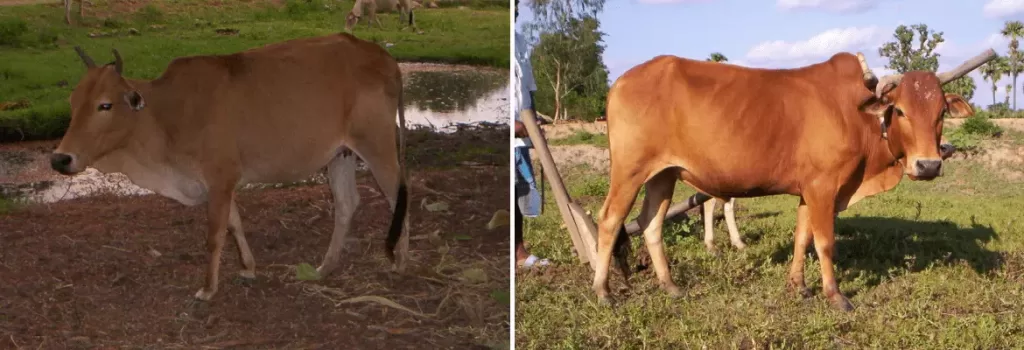
The motu cattle breed is primarily used for its draught power when it comes to hilly and undulating terrain. Motu cow Motu Bull Indian breed cows LeftMotu cow Right : Motu Bull
Other names of Motu cow breeds in indiaDeshi
Motu breed Main UseDraught, milk, manure
Motu breed Breeding TractOdisha
Motu breed Visible CharacteristicsMotu cattle are small, strong, and draft type cattle. Most cattle are polled and brown in colour.
Motu breed OriginIndian Indeginous cow breed. Its name is derived from the local area “motu” of Makangiri district in Orissa.
Motu breed ColourReddish-brown in colour. Sometimes grey or rarely white.
Motu breed Horns Shape and SizeHorns rise straight upwards. The tips of the horns are rounded.
Motu breed Milk yield per lactation(kg)100 – 140
32
Nagori cow
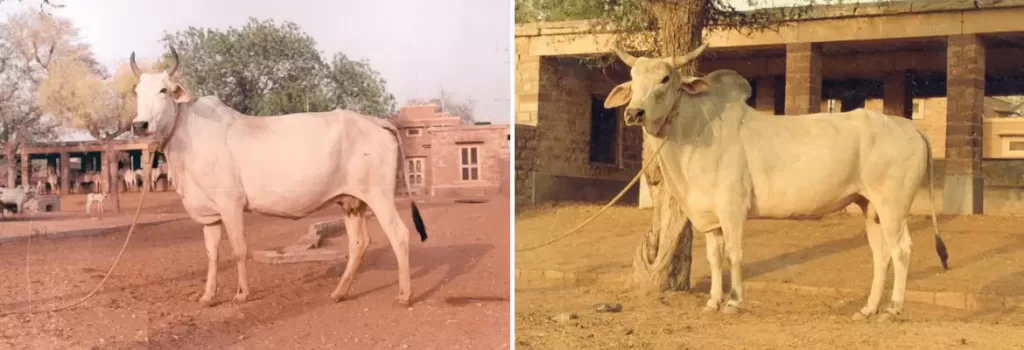
Suitable for the unrelenting climatic circumstances of Rajasthan, nagori cattle breed is maily used for labour and transport. Apart from Nagaur district, this cattle breed is also found in Jodhpur district and Nokha tehsil of Bikaner district. Nagori cow Nagori Bull Indian breed cows LeftNagori cow Right : Nagori Bull
Other names of Nagori cow breeds in india-None-
Nagori breed Main UseDraught, transport
Nagori breed Breeding TractRajasthan
Nagori breed Visible CharacteristicsThe “Nagori” is a white, upstanding, alert, and agile cattle breed with a long and narrow face similar to a horse.
Nagori breed OriginNagori is an Indian Indeginous cow breed. It derives its name from Nagaur district of Rajasthan.
Nagori breed ColourLight grey or white
Nagori breed Horns Shape and SizeThe horns are medium to small in size. The horns rise from outer edge of the poll, extending in an outward direction and gently curve upward with pointy ends.
Nagori breed Milk yield per lactation(kg)479 – 905 (Average 603)
33
Nari cow
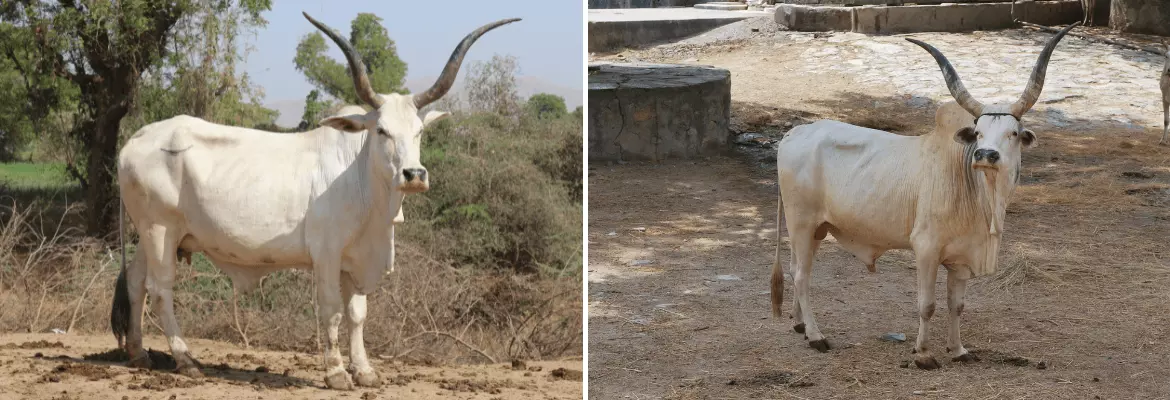
Niri cattle are dual purpose cattle, used to get milk and also for draught purposes. Around the Aravali forest range is where the majority of the Nari cattle population resides. The terrain is hilly and undulating in these regions. The region has a semi-arid tropical climate with a high mean temperature. Nari cow Nari Bull Indian breed cows LeftNari cow Right : Nari Bull
Other names of Nari cow breeds in indiaSirohi
Nari breed Main UseDraught, milk
Nari breed Breeding TractGujarat, Rajasthan
Nari breed Visible CharacteristicsThe size of Niri cattle is Medium. Male horns are mostly oriented forward while female horns are mostly oriented outward. Horns are usually wide, long, thick at the bottom, and pointed at the tips. In most cases, the forehead is broad and slightly concave.
Nari breed OriginNari cattle is an Indian Indeginous cow breed. The name Nari derives from the word Nar, which refers to hills.
Nari breed ColourGenerally white. However, grey coloured dagri cows are also there.
Nari breed Horns Shape and SizeHorns rise outward in Nari cows and forward in nari bullocks. Nari bulls have average horns length of 55.56 cm, Nari Cows have average horns length of 51.68 cm.
Nari breed Milk yield per lactation(kg)1118 – 2222 (Average 1647)
34
Nimari cow
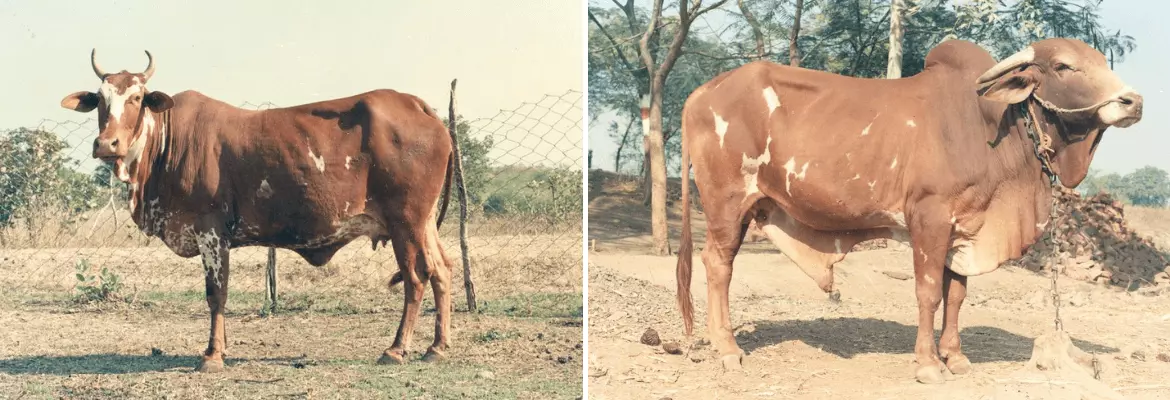
The Nimari cattle breed is primarily used in farming activities as well as for transportation. They are mainly found in the central parts of Khargaon, Badwani districts, and few are found in the bordering Dhar district and surrounding areas of Madhya Pradesh and Maharashtra. Nimari cow Nimari Bull cow breeds in india LeftNimari cow Right : Nimari Bull
Other names of Nimari cow breeds in indiaKhargoni, Khargaon, Khurgoni
Nimari breed Main UseDraught, transport
Nimari breed Breeding TractMadhya Pradesh
Nimari breed Visible CharacteristicsNimari cattle is brownish-red in colour and has a huge body structure. The brownish-red coat also has white spots on it.
Nimari breed OriginNimari is an Indian Indeginous cow breed. It is named after the Niamr region og Madhya Pradesh. Nimari cattle are crossbred from Gir and Khillari cattle. The color of its coat, its massive body structure, and convexity of its forehead are all attributes of its Gir genes, whereas its Khillari genes contribute to its hardiness, agility, and temper.
Nimari breed ColourBrownish red with white spotting.
Nimari breed Horns Shape and SizeIt is common for horns to rise in a backward direction from the outer edge of the poll, somewhat in the same way as in Gir cattle, before turning upward, outward, and finally inward.
Nimari breed Milk yield per lactation(kg)600 – 954 (Average 766.9)
35
Ongole cow
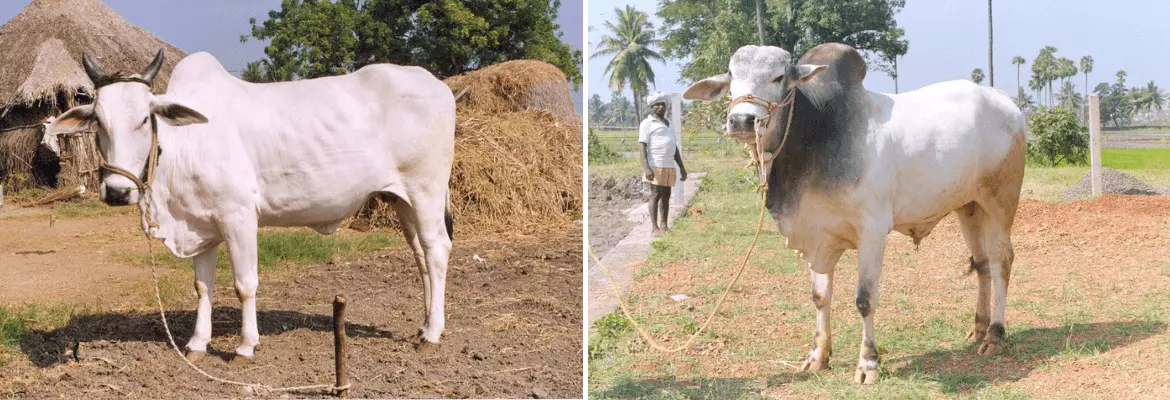
Ongole cattel breed is found all along the coast from Nellore to Vizianagram. Ongoles are exported to several countries. The USA imported it for beef; Brazil imported it for beef and milk; Sri Lanka, Fiji and Jamaica imported it for draught; Australia imported it for heat tolerance and beef; and Switzerland imported it for disease resistance. Ongole cow Ongole Bull cow breeds in india LeftOngole cow Right : Ongole Bull
Other names of Ongole cow breeds in indiaNellore
Ongole breed Main UseDraught, milk
Ongole breed Breeding TractAndhra Pradesh
Ongole breed Visible CharacteristicsKnown for their magnificent gait, stumpy horns, large, fleshy, serrated dewlaps, and smooth, flowing folds rather than tight constrictions, Ongole cattle are easily distinguishable.
Ongole breed OriginIndian Indigenous cow breed.
Ongole breed ColourGlossy white coat ( called padakateeru in local Telugu language). Dark grey markings appear on the head, neck, and hump of males. There are also black points on the knees and pasterns. The muzzel and eyelashes are black.
Ongole breed Horns Shape and SizeHorns are thick at the base and short and stumpy. Horns rise outwards and backwards. Horns are Ongole cows are thinner then ongole bulls.
Ongole breed Milk yield per lactation(kg)688
36
Ponwar cow
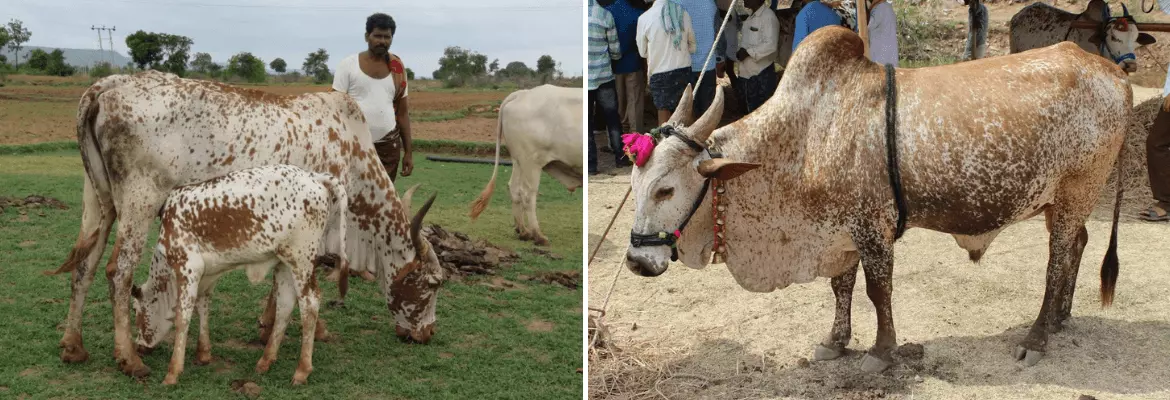
Ponwar bullocks are fast-moving, ideal for farming activities and provide an important source of income to the farmers. Puranpur tehsil, located in Pilibhit district, is the home to ponwar cattle breed. Ponwar cattle is found in Mainakot, Mazara, Bhirkhera, Faizulaganj and Rajpur Semra villages. Ponwar cow Ponwar Bull cow breeds in india LeftPonwar cow Right : Ponwar Bull
Other names of Ponwar cow breeds in indiaPurnea
Ponwar breed Main UseDraught, transport
Ponwar breed Breeding TractUttar Pradesh
Ponwar breed Visible CharacteristicsIt’s a medium to large size cattle with piculiar whit spotting on white coat.
Ponwar breed OriginBreeders believe this breed is a cross between plain cattle and hill cattle. This breed might have originated from Nepalese hill cattle (Morang) and local white cattle.
Ponwar breed ColourBrown or black with white coloured patches. The white coloured patching doesnt have any pattern.
Ponwar breed Horns Shape and SizeThe horns medium sized and rise outward, upward and bend inward with pointy tips.
Ponwar breed Milk yield per lactation(kg)459
37
Poda Thirupu / PodaThurpu cow
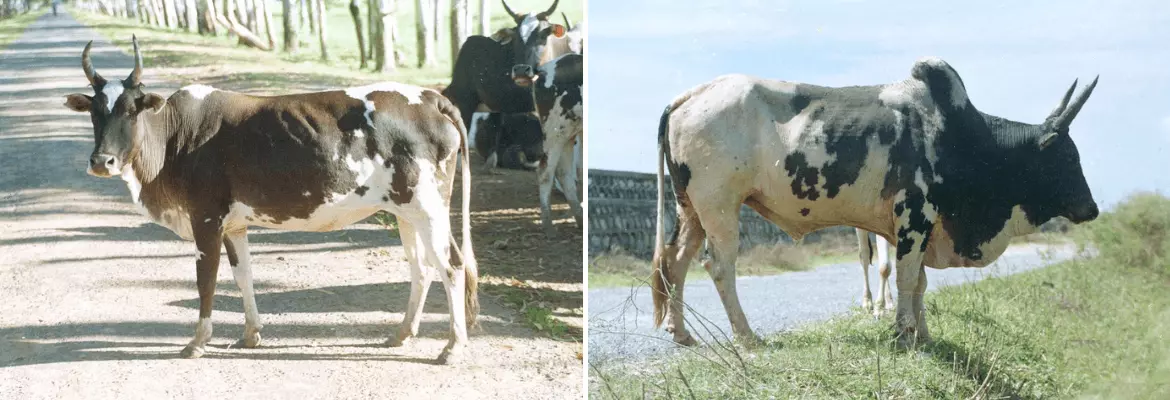
Poda Thirupu bullocks are powerful and excellent for heavy plowing and carting. This cattle is are fast and agile. Poda Thirupu cow Poda Thirupu Bull cow breeds in india LeftPoda Thirupu cow Right : Poda Thirupu Bull
Other names of Poda Thirupu / PodaThurpu cow breeds in indiaThurpu, Poda Edlu, Thurpu Edlu
Poda Thirupu breed Main UseDraught, milk, manure
Poda Thirupu breed Breeding TractTelangana
Poda Thirupu breed Visible CharacteristicsPodaThurpu cattle is of medium size with a compact body. A white coat with brown patches or a red/brown coat with white patches. The entire body is covered in patches. It is most common to find patches on the posterolateral sides. The base of the horns is broad. Majority of animals have a convex forehead with a deep groove at the centreort bodies.
Poda Thirupu breed OriginPoda Thirupu is an Indian Indeginous cow breed. This breed of cattle is known as Poda Edlu (Poda locally means spotted or speckled/blotched), it typically has speckled/blotched fur (brown spots on white skin). In western Telangana, the cattle breed is known as Thurpu Edlu. Farmers who use these bullocks for draught purposes call them Thurpu Edlu (meaning East in Telugu, while Edlu means bullocks in local language). They originated on the eastern side of the Telangana district.
Poda Thirupu breed ColourLight brown to dark brown patches on white coat.
Poda Thirupu breed Horns Shape and SizeThe horns are usually straight, occasionally curved backwards and forward-pointing. Poda Thirupu Bulls have an average horn length of 31.85 cm, Poda Thirupu Cows have an average horn length of 29.98 cm.
Poda Thirupu breed Milk yield per lactation(kg)494 – 646 (Average 570)
38
Pulikulam cow
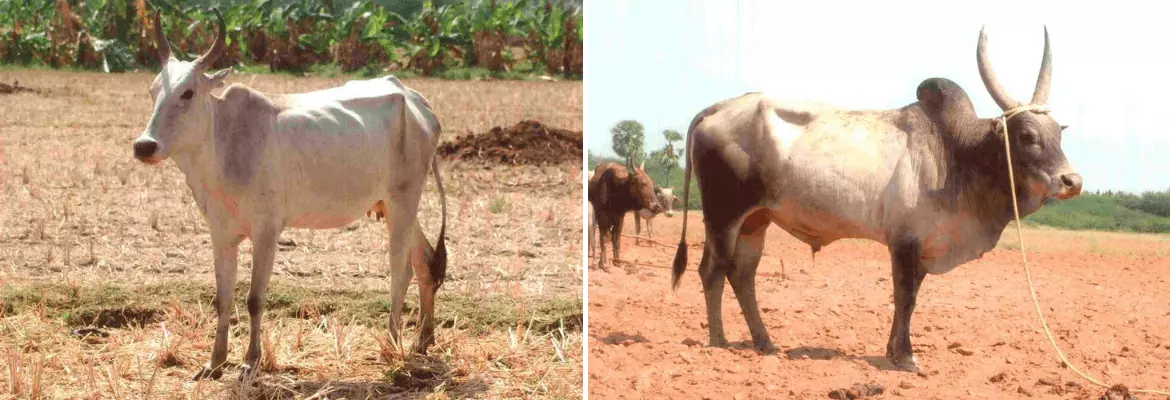
Pulikulam cattle do well on extensive grazing in the tropical climate of the area in open housing. Pulikulam Bulls are used for the sport of Bull riding (Jallikattu), which is very popular in the area. Pulikulam cow Pulikulam Bull cow breeds in india LeftPulikulam cow Right : Pulikulam Bull
Other names of Pulikulam cow breeds in indiaMattu Maadu, Jallikattu maadu, Kilakattu maadu, Palingu maadu, Mani maadu,
Pulikulam breed Main UseDraught, manure, game (Jallikattu)
Pulikulam breed Breeding TractTamilnadu
Pulikulam breed Visible CharacteristicsPulikulam cattle are small, compact, and have short legs. Muzzle, eyelids, tail switch, and hooves are black. Forehead is broad and level with a groove at the centre. Pulikulam bulls have a large bump while Pulikulam cows have a small bump. The udder is not well developed.
Pulikulam breed OriginPulikulam cattle is an Indian Indeginous cattle breed. These cattles derive their name from the village Pulikulam.
Pulikulam breed ColourPulikulam bulls are dark grey, and Pulikulam cows are grey or white.
Pulikulam breed Horns Shape and SizeHorns are Curved. With pointed tips, the horns bend outwards, upwards, backwards and inwards. The tips of the horns are wide apart. Pulikulam Bulls have an average horn length of 34.34 cm, Pulikulam Cows have an average horn length of 37.22 cm.
Pulikulam breed Milk yield per lactation(kg)-None-
39
Punganur cow
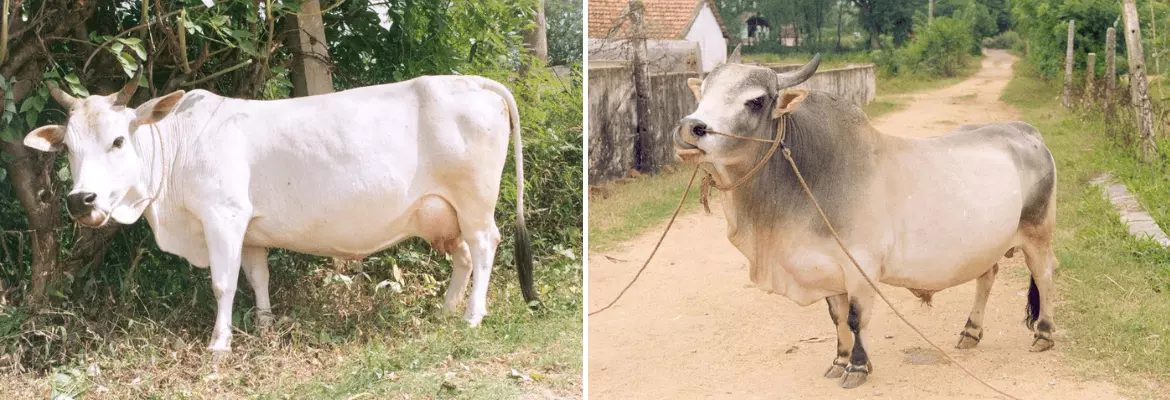
Farming activities on light types of soil are conducted with punganur cattle. The Punganur bull is used for carts like tongas for racing games. Punganur cow Punganur Bull cow breeds in india LeftPunganur cow Right : Punganur Bull
Other names of Punganur cow breeds in india-None-
Punganur breed Main UseDraught, milk, transport
Punganur breed Breeding TractAndhra Pradesh
Punganur breed Visible CharacteristicsThe punganur have a small physique.
Punganur breed OriginPunganur is an Indian Indeginous cow breed. Rulers of Punganur developed this breed. Thus, this breed is known as Punganur after the name of the area.
Punganur breed ColourWhite, grey, light brown, dark brown, or red are the common colors of Punganur cattle. Occasionally, white coat cattle are mixed with either a red or black colour.
Punganur breed Horns Shape and SizeHorns are small to medium-sized and crescent-shaped and often loose, curving backwards and forward in punganur bulls and forward and lateral in panganur cows.
Punganur breed Milk yield per lactation(kg)194 – 1100 (Average 546)
40
Purnea cow
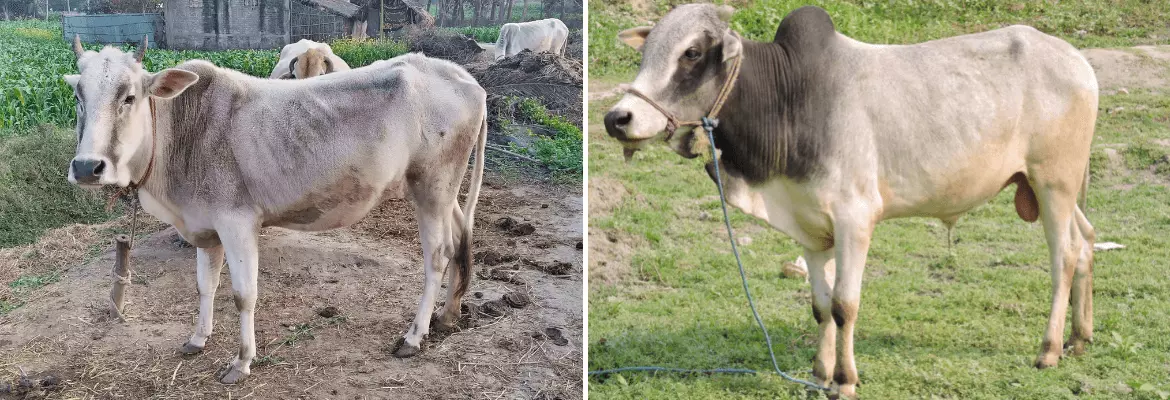
Seemanchal region of Bihar is home to Purnea cattle, which are distributed in Araria, Purnea and Katihar, and adjoining Kishanganj, Supaul, and Madhepura districts. The Purnea cattle has a very good drought and heat tolerance. Purnea cow Purnea Bull cow breeds in india LeftPurnea cow Right : Purnea Bull
Other names of Purnea cow breeds in india-None-
Purnea breed Main UseDraught, milk, manure
Purnea breed Breeding TractBihar
Purnea breed Visible CharacteristicsA Purnea cattle is a small animal. They have a medium hump, a small to medium dewlap, a small naval flap, and a small to the medium udder. The head is medium in size. While most Purnea cattle have flat polls, some have somewhat prominent polls.
Purnea breed OriginPurnea is an Indian Indeginous cow breed. This cattles derives its name from purnea district in Bihar (which is part of its breeding tract).
Purnea breed ColourPrimarily grey but occasionally red and black.
Purnea breed Horns Shape and SizeTheir horns are small, straight, and mostly carried upwards, but sometimes laterally as well. Purnea Bulls have an average horn length of 8.3 cm, Purnea Cows have an average horn length of 7.1 cm.
Purnea breed Milk yield per lactation(kg)452 – 785 (Average 609.1)
41
Rathi cow
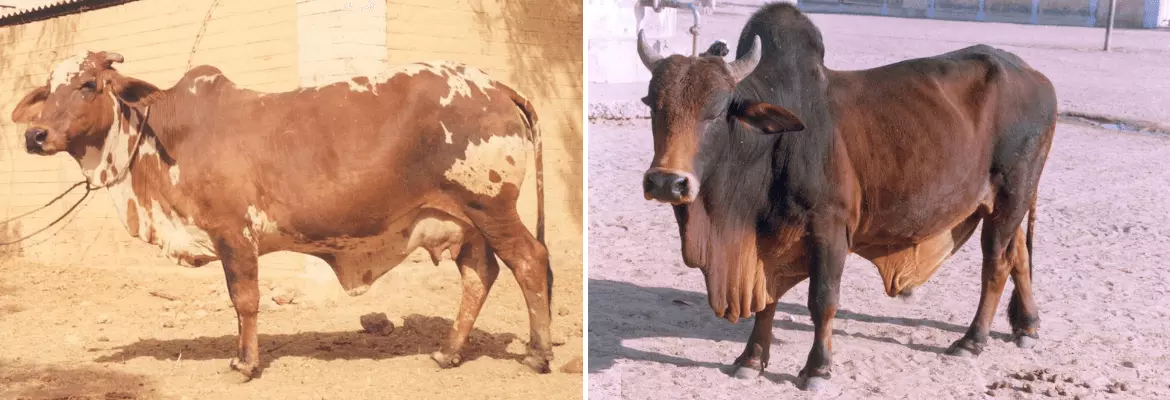
The Rathi cattle breed is especially prevalent in Loonkaransar tehsil of Bikaner district. This region is also known as rathi tract. This breed is well accustomed to desert conditions. Rathi cow Rathi Bull cow breeds in india LeftRathi cow Right : Rathi Bull
Other names of Rathi cow breeds in india-None-
Rathi breed Main UseMilk
Rathi breed Breeding TractRajasthan
Rathi breed Visible CharacteristicsThe face of Rathi cattle is broad between the eyes and slightly dishevelled. The dewlap is fine and loose. The tail is long and fine and tapers to a good black or white switch well below the hock.
Rathi breed OriginIndian Indeginous cow breed. There are pastoral tribes called Raths who breed this cattle breed, and who live a nomadic life. The name of this brred is derived from the name of rath tribe. Apparently, Rathi cattle are a mixture of Sahiwal, Red Sindhi, Tharparkar, and Dhanni breeds with a high proportion of Sahiwal blood.
Rathi breed ColourGenerally, rathi cattle have brown coats with white patches all over, but cattle with completely brown coats or black coats with white patches are also common. In general, the lower body parts are lighter in color than the rest of the body.
Rathi breed Horns Shape and SizeHorns are short to medium-sized and curve outward, upward, and inward. .
Rathi breed Milk yield per lactation(kg)1062 – 2810 (Average 1560)
42
Red Kandhari cow
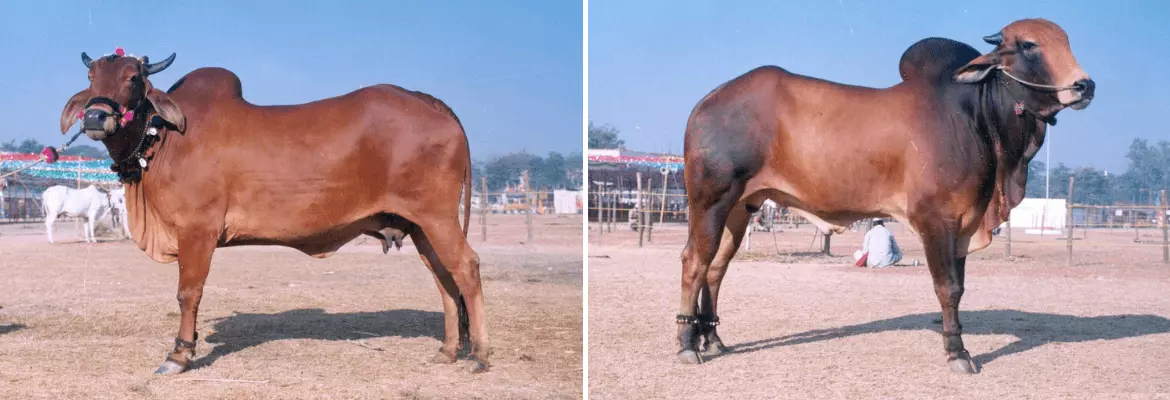
The Red Kandhari is found in Kandhar, Mukhed, Nanded, and Biloli tehsils of Nanded district, and in Ahmadpur, Parli, and Hingoli tehsils of Latur district. The red Kandhari bull is used for heavy work. Red Kandhari cow Red Kandhari Bull cow breeds in india LeftRed Kandhari cow Right : Red Kandhari Bull
Other names of Red Kandhari cow breeds in indiaLakhalbunda
Red Kandhari breed Main UseDraught, Transport
Red Kandhari breed Breeding TractMaharashtra
Red Kandhari breed Visible CharacteristicsThe red coat and big size are a distinctive charecteristics of red kandhari cattle breed.
Red Kandhari breed OriginRed Kanhari, now referred to as Red Kandhari, was the breed named in memory of Raja Somdeori’s father Raja Kanhar. Having a red color and common in the Kandhar tehsil of Nanded district, the breed naturally acquires the name Red Kandhari.
Red Kandhari breed ColourGenerally, the color is a deep, dark red, but there are variations from dull red to almost brown. Red kandhari Cows are typically lighter in color than red kandhari bulls.
Red Kandhari breed Horns Shape and SizeThis breed has medium sized horns hich are evenly curved.
Red Kandhari breed Milk yield per lactation(kg)598
43
Red Sindhi cow
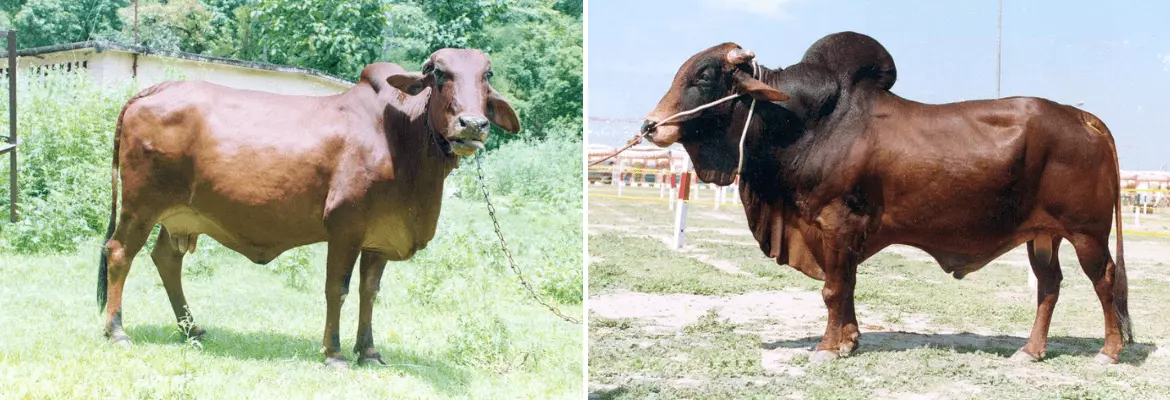
Originally bred in Pakistan, organized herds have been established in the Indian states of Orissa, Tamil nadu, Bihar, Kerala, and Assam. Red Sindhi cow Red Sindhi Bull cow breeds in india LeftRed Sindhi cow Right : Red Sindhi Bull
Other names of Red Sindhi cow breeds in indiaSindhi, Malir, Red Karachi
Red Sindhi breed Main UseMilk
Red Sindhi breed Breeding TractOriginally from region of pakistan, but in India Orissa, Tamil nadu, Bihar, Kerala and Assam has this breed
Red Sindhi breed Visible CharacteristicsDistinct red colour and large size.
Red Sindhi breed OriginLas Bela cattle, found in the Baluchistan state of Bela, are believed to have been the ancestors of Red Sindhis.
Red Sindhi breed ColourRed is the dominant color of this breed. The colour varies from dark red to dim yellow. Despite patches of white on the dewlap and sometimes on the forehead, there are no large patches of white on the body. The shoulders and thighs of red Sindhi bulls are darker in colour.
Red Sindhi breed Horns Shape and SizeHorns are small to medium in size. They appear lateral and curving upward and are thick at the base.
Red Sindhi breed Milk yield per lactation(kg)1100 – 2600 (Average 1840)
44
Sahiwal cow
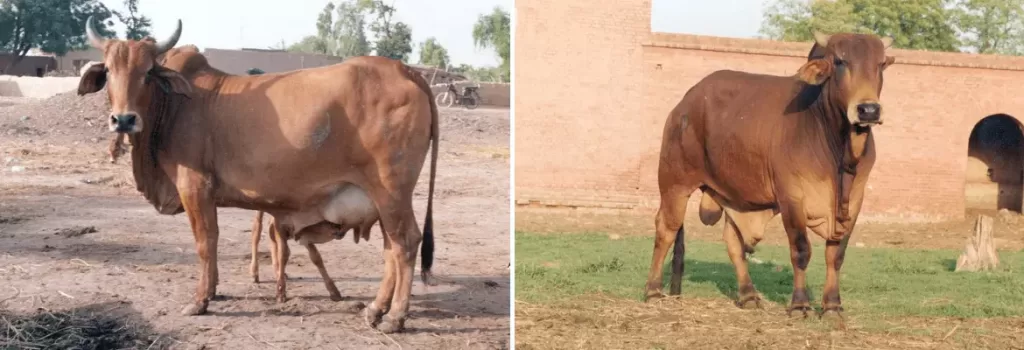
A Sahiwakl is one of the best dairy breeds of Zebu cattle. It is being used for the betterment of local stock. The towns of Fazilka and Abohar in Ferozepur district have a few herds of pure Sahiwal cattle. Sahiwal cow Sahiwal Bull cow breeds in india LeftSahiwal cow Right : Sahiwal Bull
Other names of Sahiwal cow breeds in indiaLola, Montgomery, Lambi Bar, Teli, Multani
Sahiwal breed Main UseMilk
Sahiwal breed Breeding TractRajasthan, Punjab
Sahiwal breed Visible CharacteristicsA pale red color, short horns, and loose skin are visual characteristics of sahiwal cattle breed.
Sahiwal breed OriginThis breed gets its name from the Sahiwal area of Montgomery district in Punjab.
Sahiwal breed ColourSahiwal cattle have brownish red coloring. The coat colors may vary from a mahogany reddish-brown to a greyish red. Sahiwal bulls have darker extremities than the rest of their bodies. A few patches of white may appear occasionally.
Sahiwal breed Horns Shape and SizeA Sahiwal cattle’s horns are stumpy and short to medium, and they run outwards, upwards, and then inwards.
Sahiwal breed Milk yield per lactation(kg)1600 – 2750 (Average 2325)
45
Shweta Kapila cow
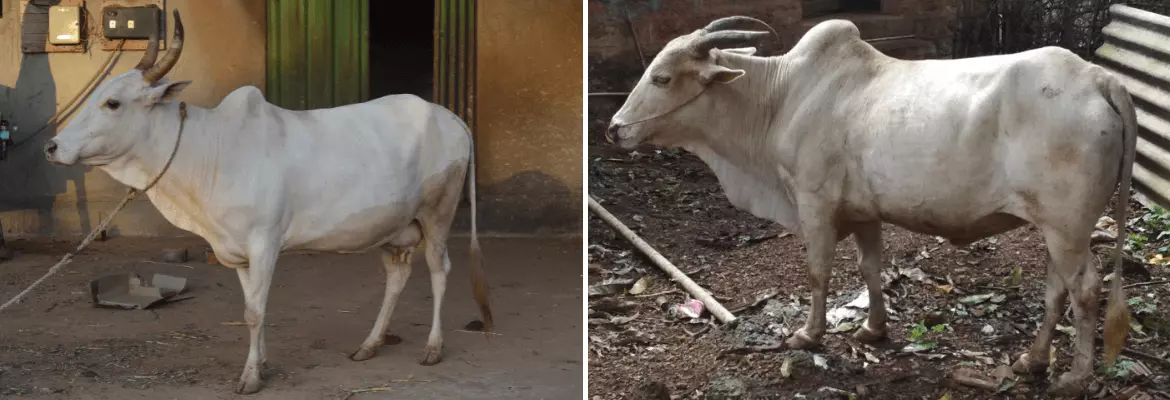
Shweta kapila cattle breed is well adapted to hot and humid conditions. Farmers and elders in the Valpoi and Seekeri region (North Goa) believe that Shweta kapila cow milk has medicinal properties. Shweta Kapila cow Shweta Kapila Bull cow breeds in india LeftShweta Kapila cow Right : Shweta Kapila Bull
Other names of Shweta Kapila cow breeds in indiaGavthi dhavi, Gaunthi
Shweta Kapila breed Main UseMilk
Shweta Kapila breed Breeding TractGoa
Shweta Kapila breed Visible CharacteristicsShweta kapila Cattle is completely white in colour. The white color extends from muzzle to tail switch, including eyelashes and muzzle(whitish brown). These cattle have a short to medium stature and a small to medium sized hump. The face is straight.
Shweta Kapila breed OriginIt is an Indian Indigenous cow breed. Kapila refers to a uniformly coloured cow, while shwet refers to white colour.
Shweta Kapila breed ColourWhite.
Shweta Kapila breed Horns Shape and SizeMedium sized straight horns that may be, at times, slightly curved upward and outward. Average size of Shweta kapila cattle is 20-27 cm.
Shweta Kapila breed Milk yield per lactation(kg)350 – 650 (Average 510)
46
Siri cow
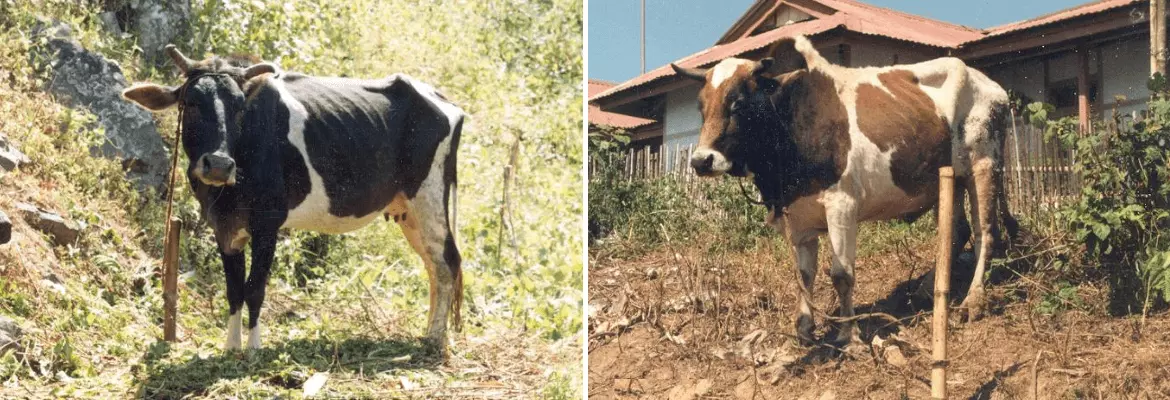
Siri bulls are main source of draught power in their breeding tract. Siri cow Siri Bull cow breeds in india LeftSiri cow Right : Siri Bull
Other names of Siri cow breeds in indiaTrahbum
Siri breed Main UseDraught
Siri breed Breeding TractSikkim, West Bengal
Siri breed Visible CharacteristicsGenerally like Holstein Friesian in colour, with a cervicothoracic type hump covered in hair .
Siri breed OriginSiri is an Indian Indigenous cow breed.
Siri breed ColourBrown with white patches or black with white patches. Ocationally completely black or brown as well.
Siri breed Horns Shape and SizeThe horns are medium in size and bend outward, forward, and upward slightly, with sharp tips.
Siri breed Milk yield per lactation(kg)425.8
47
Tharparkar cow
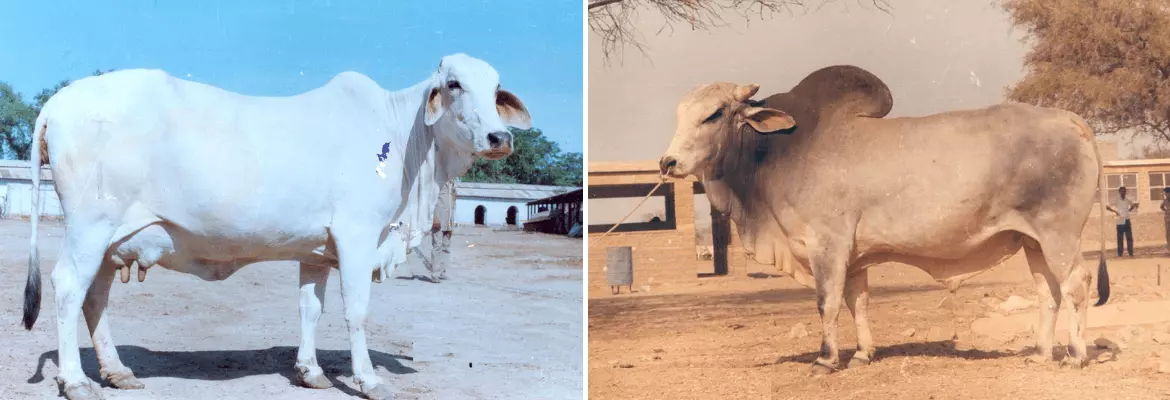
Tharparkar cattles are well suited for harsh climatic conditions of Thar dessert. The Tharparkar cattle are found along the Indo-Pak border in Western Rajasthan and up to the Rann of Kutch in Gujarat. Tharparkar cow Tharparkar Bull cow breeds in india LeftTharparkar cow Right : Tharparkar Bull
Other names of Tharparkar cow breeds in indiaGrey Sindhi, Thari, White Sindhi
Tharparkar breed Main UseDraught, milk
Tharparkar breed Breeding TractRajasthan, Gujarat
Tharparkar breed Visible CharacteristicsTharparkar cattles have a convex forehead.
Tharparkar breed OriginIndian Indeginous cow breed. Tharparkar gets its name from the Thar Desert, its place of origin.
Tharparkar breed ColourTharparkar cattle are white or light grey in color. The face and extremities are darker than the body. Tharparkar bulls have a dark neck, hump, forequarters, and hindquarters.
Tharparkar breed Horns Shape and SizeThe horns are set well apart and curve gradually upward and outward in the same direction as the poll. The horns have blunt points that are angled inward. The horns base measure 12.5 to 17.5 cm in circumference and is moderately thick. Tharparkar bulls have short, thick horns.
Tharparkar breed Milk yield per lactation(kg)913 – 2147 (Average 1749)
48
Thutho cow
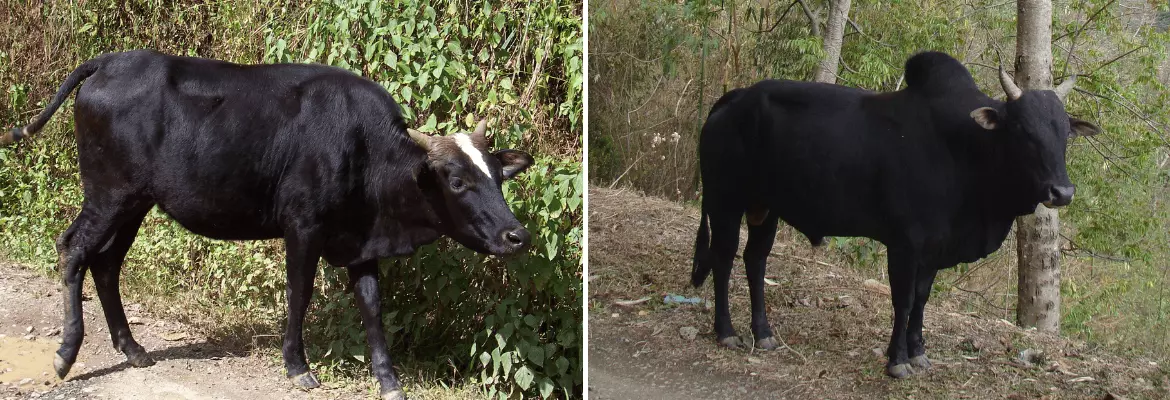
Available in almost all the districts of its breeding tract in nagaland, thutho cattle breed is well adapted to warm subtropical climatic conditions. These cattles are maily rared for draught and meat. Thutho cow Thutho Bull cow breeds in india LeftThutho cow Right : Thutho Bull
Other names of Thutho cow breeds in indiaSheapi, Tseso, Ameshi, Sheapi
Thutho breed Main UseDraught, manure, meat
Thutho breed Breeding TractNagaland
Thutho breed Visible CharacteristicsThutho are a medium sized Indian breed cows that are docile and well built. Forehead of this cattle is straight and small. The backline is bumpy and slants behind the small hump, then rises to peak between the hipbones and then descends abruptly to the tail head.
Thutho breed OriginIndian Indeginous cow breed.
Thutho breed ColourBrown or black. Occasionally with white spotting on body or face.
Thutho breed Horns Shape and SizeThe horns are short and stumpy. The horns bend outwards and then upwards.
Thutho breed Milk yield per lactation(kg)-None-
49
Umblachery cow
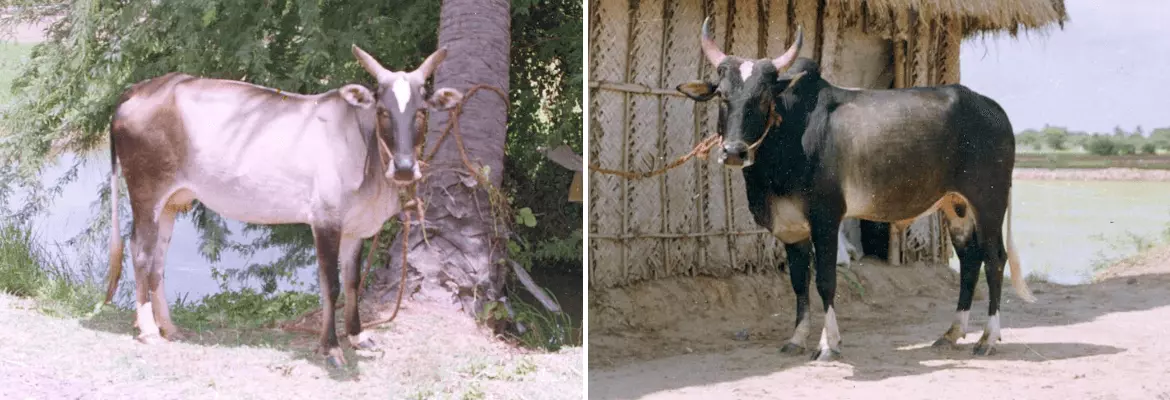
Umbalachery is a light-bodied draught cattle developed for marshy paddy fields. Due to their light weight, the Umbalachery breed is very well suited to work in the alluvial type of soil of this area. Umblachery cattles are found in All the unions of Thiruvarur district; Keelalyur, Kelvelur, Nagapattinam, Thalaignayar, Thirumarugal and Vedaranyam and the unions of Nagapattinam district of Tamil Nadu. Umblachery cow Umblachery Bull cow breeds in india LeftUmblachery cow Right : Umblachery Bull
Other names of Umblachery cow breeds in indiaMottaimadhu, Southern, Therkuthimadhu, Tanjore, Molaimadhu, Jathimadu
Umblachery breed Main UseDraught
Umblachery breed Breeding TractTamilnadu
Umblachery breed Visible CharacteristicsWhite markings can be seen on the face, limbs, and tail of this cattle. White marks are visible on all legs below the hocks, appearing like socks or stockings.
Umblachery breed OriginUmbalachery is a small village in the Thalaignayar union in Nagapattinam district, where this cattle derives its name from.
Umblachery breed ColourAt birth, the coat is red and changes to grey by three to four months of age. Umblachery bulls have black extremities and a dark gray coat. Umblachery cows are grey in color, with light dark grey patches on the face, neck, and hips.
Umblachery breed Horns Shape and SizeThe horns, very small in size, bend outward and inward, sometimes spreading laterally. Horns are thick in Umblachery bulls and thin in Umblachery cows.
Umblachery breed Milk yield per lactation(kg)494
50
Vechur cow
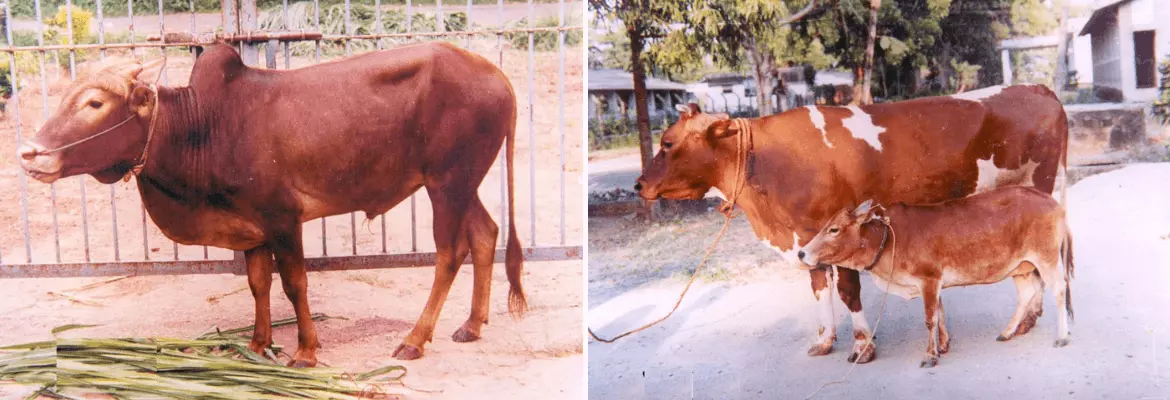
Vechur cattle produce more milk than other dwarf cattle in this area. These Indian breed cows belong to Kuttanad. Kuttanad is a unique agricultural tract that includes Alappuzha, Kottayam, Pathanamthitta, and Kasaragod districts in Kerala. Vechur cattle are well adapted and evolved to the social (local culture and low input from domestic animals) and climatic conditions (heavy rains and humid weather) of the region. As animals with a smaller structure are much suited in this breeding tract. Vechur cow Vechur Bull cow breeds in india LeftVechur cow Right : Vechur Bull
Other names of Vechur cow breeds in india-None-
Vechur breed Main UseMilk, Manure
Vechur breed Breeding TractKerala
Vechur breed Visible CharacteristicsThe Vechur cattle are notable for their compact bodies and small size.
Vechur breed OriginIt derives its name from a place called Vechur which is situated near Vaikam in Kottayam district of South Kerala, by the side of the Vembanad lake.
Vechur breed ColourVechur cattle are light red, black, fawn and white in color.
Vechur breed Horns Shape and SizeCurving forward and downward, the Horns are small and thin. They can be extremely small and barely visible in some cases.
Vechur breed Milk yield per lactation(kg)561